
Choosing between retirement accounts might seem boring, but these decisions determine whether you retire comfortably or struggle. The right mix of accounts can save hundreds of thousands in taxes over a career. Here is how to think about it.
Both 401(k)s and IRAs help you save for retirement with tax advantages, but they work differently and have different rules.
401(k) Basics
A 401(k) is an employer-sponsored retirement plan. You contribute directly from your paycheck, often with employer matching. According to Vanguard's How America Saves report, the average 401(k) balance is approximately $134,000, but the median is only about $35,000, reflecting that many workers are not contributing enough.
2026 Contribution Limits
Employee contribution: $24,500 under 50
Catch-up contribution for workers 50 and older: $8,000, bringing the total employee limit to $32,500
Total contribution including employer match: $72,000 (or $80,000 with catch-up)
Types of 401(k)s
Traditional 401(k): Contributions are pre-tax, reducing your taxable income now. You pay taxes on withdrawals in retirement. Consider a scenario: someone in the 22% tax bracket contributes $24,500 to a Traditional 401(k). Their taxable income drops by $24,500, saving them $5,170 in federal taxes that year. That tax savings can be invested elsewhere for additional growth.
Roth 401(k): Contributions are after-tax with no tax break now, but all withdrawals in retirement are tax-free. This is particularly powerful for younger workers who expect to be in higher tax brackets later. A $24,500 Roth 401(k) contribution that grows at 7% for 30 years becomes approximately $179,000, all withdrawn tax-free.
401(k) Pros and Cons
Pro: Highest contribution limits of any retirement account
Pro: Employer matching is free money, an instant return of 50-100%
Pro: Automatic payroll deductions make saving effortless
Con: Limited investment options chosen by your employer
Con: Often higher fund expense ratios than what you could find independently
Con: Early withdrawal penalty of 10% before age 59.5 (with some exceptions)
IRA Basics
An IRA or Individual Retirement Account is opened on your own at a brokerage. You have complete control over investments, including individual stocks, bonds, ETFs, index funds, and more. This flexibility is one of the IRA's biggest advantages over a 401(k).
2026 Contribution Limits
$7,500 under 50 or $8,600 if 50 or older (the extra $1,100 is the catch-up contribution)
Limit applies across all IRAs combined, not per account
You must have earned income at least equal to your contribution
Types of IRAs
Traditional IRA: Contributions may be tax-deductible depending on income and whether you have a workplace plan. If you are covered by an employer plan, the 2026 deduction phases out between $81,000-$91,000 MAGI for single filers and $129,000-$149,000 for married filing jointly. Withdrawals are taxed as ordinary income.
Roth IRA: Contributions are after-tax. All growth and qualified withdrawals are completely tax-free. No required minimum distributions during your lifetime. The 2026 income limits for Roth IRA contributions are: full contribution up to $150,000 MAGI for single filers (phaseout $153,000-$168,000), and up to $236,000 for married filing jointly (phaseout $242,000-$252,000). If your income exceeds these limits, consider a backdoor Roth IRA conversion, see our Roth IRA conversion guide for details.
IRA Pros and Cons
Pro: Full control over investment choices, access to thousands of funds and individual securities
Pro: Generally lower expense ratios than 401(k) plan options
Pro: Roth IRA has no required minimum distributions
Pro: Roth IRA contributions (not earnings) can be withdrawn penalty-free at any time
Con: Much lower contribution limits than 401(k)
Con: No employer match available
Con: Income limits restrict Roth IRA eligibility for high earners
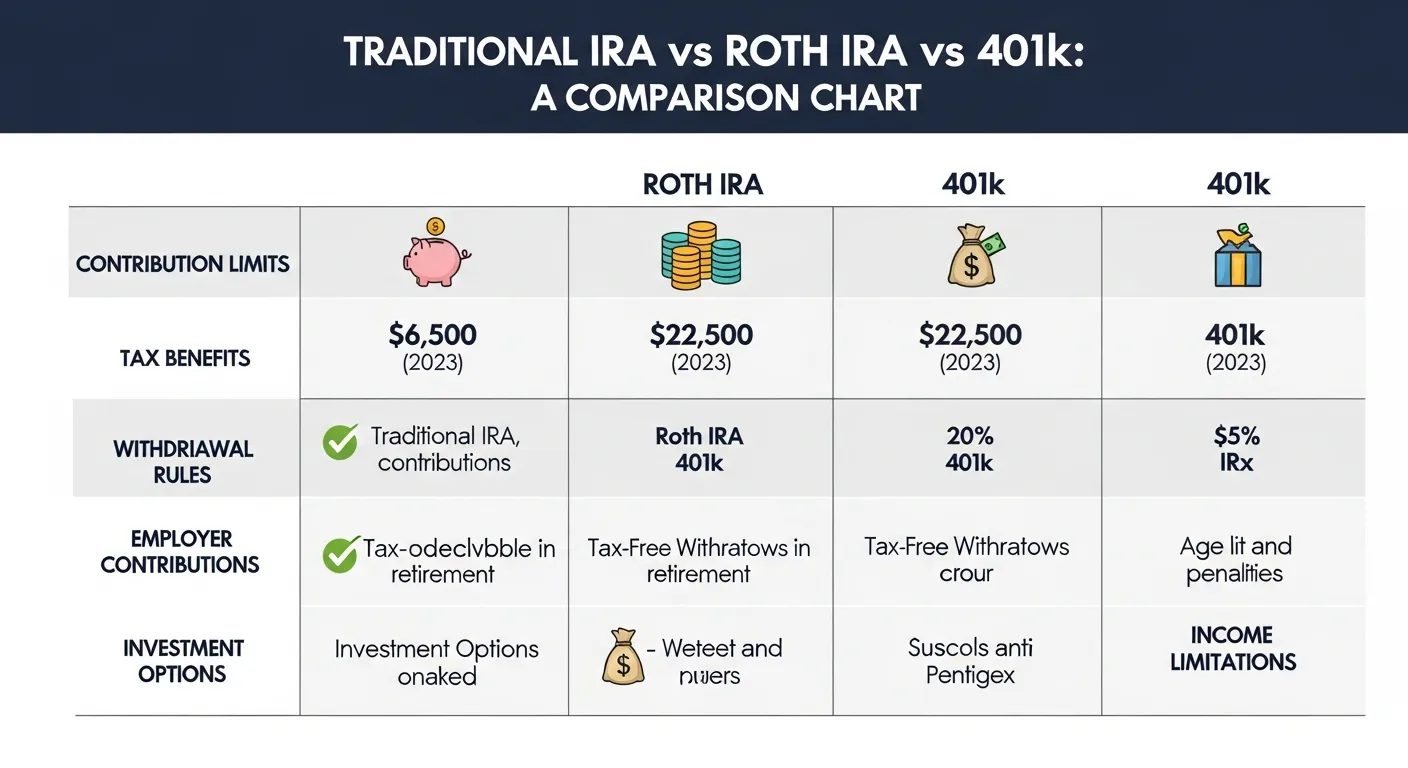
IRA vs 401(k) Comparison Table
Feature | 401(k) | Traditional IRA | Roth IRA |
|---|---|---|---|
2026 Contribution Limit | $24,500 ($32,500 with catch-up) | $7,500 ($8,600 with catch-up) | $7,500 ($8,600 with catch-up) |
Tax Treatment | Traditional: pre-tax; Roth: after-tax | Tax-deductible (income limits apply) | After-tax contributions, tax-free growth |
Employer Match | Yes, often 3-6% of salary | No | No |
Investment Options | Limited to plan offerings | Virtually unlimited | Virtually unlimited |
Income Limits | None for contributions | Deductibility phases out at higher incomes | $153K-$168K single/HOH; $242K-$252K married filing jointly |
Required Minimum Distributions | Yes, starting at age 73 | Yes, starting at age 73 | None during owner's lifetime |
Early Withdrawal Penalty | 10% before age 59.5 | 10% before age 59.5 | Contributions: none; Earnings: 10% before 59.5 |
Loan Option | Yes (if plan allows) | No | No |
Which Account Should You Fund First?
Here is the strategy most financial planners recommend, listed in priority order:
401(k) up to the employer match: Always capture the full match. This is an instant 50-100% return. If your employer matches 50 cents for every dollar up to 6% of salary, contribute at least 6%. Learn more in our 401(k) basics guide.
Max out a Roth IRA ($7,500): Tax-free growth is incredibly valuable, especially if you are young. The flexibility to withdraw contributions penalty-free also provides a safety net. Open one at Fidelity, Schwab, or Vanguard with no minimums.
Return to 401(k) and max it out ($24,500): Use remaining contribution room for additional tax-advantaged savings. Even if your plan's fund options are not ideal, the tax benefits outweigh slightly higher fees. Keep any cash you need within the next 1 to 3 years in a HYSA or CD rather than investing it.
HSA if eligible ($4,400 individual / $8,750 family): If you have a high-deductible health plan, an HSA offers triple tax benefits, tax-deductible contributions, tax-free growth, and tax-free withdrawals for medical expenses. After age 65, it functions like a Traditional IRA for non-medical withdrawals.
Taxable brokerage: Once all tax-advantaged accounts are maxed, invest in a regular brokerage account. You will pay capital gains taxes on profits, but there are no contribution limits or withdrawal restrictions.
Consider a scenario: someone earning $80,000 per year with a 4% employer match follows this priority order. They contribute $3,200 to the 401(k) to capture the match, then $7,500 to a Roth IRA, then an additional $20,300 to the 401(k). Total tax-advantaged savings: $30,500 per year. At 7% average returns over 25 years, that grows to approximately $2.4 million. Learn how to calculate your target number in our retirement savings guide.
Roth vs Traditional: Which is Better?
Choose Roth If:
You are in a lower tax bracket now than you expect in retirement
You are young with decades of tax-free growth ahead
You want no required minimum distributions
You believe tax rates will rise in the future
You want the flexibility to withdraw contributions without penalty
Choose Traditional If:
You are in a high tax bracket now (24% or above)
You expect to be in a lower bracket in retirement
You want to reduce your current taxable income immediately
You are near retirement and have limited time for tax-free compounding
The Case for Both
Many financial advisors recommend contributing to both Roth and Traditional accounts to create tax diversification. Having both pre-tax and after-tax retirement funds gives you flexibility to manage your tax bracket in retirement. You can withdraw from Traditional accounts up to the top of a lower bracket, then pull additional funds from Roth accounts tax-free. This strategy can save tens of thousands in retirement taxes over time. For more on converting existing Traditional balances to Roth, see our Roth IRA conversion guide.
Common Retirement Account Mistakes
Not contributing enough to get the full employer match: According to Vanguard, roughly 20% of eligible workers miss out on free employer match money. This is the closest thing to a guaranteed return in investing.
Cashing out when changing jobs: The Employee Benefit Research Institute found that 40% of workers cash out their 401(k) when leaving a job. After taxes and the 10% early withdrawal penalty, a $50,000 balance becomes roughly $32,500, and you lose decades of compound growth. Always roll over to an IRA or your new employer's plan.
Investing too conservatively: Young workers with 30+ years until retirement who invest entirely in bonds or money market funds miss out on significant growth. A portfolio earning 4% instead of 7% over 30 years produces roughly half the final balance.
Ignoring fees: Some 401(k) plans charge fund expense ratios of 1% or higher. Over a career, that 1% fee can reduce your final balance by 25% or more. Choose the lowest-cost index fund options available in your plan.
Not increasing contributions with raises: Every time you receive a raise, increase your contribution rate by at least 1%. This gradual approach eventually gets you to the maximum without a sudden lifestyle change.
The Bottom Line
Do not overthink this. The most important thing is to save consistently for retirement. Whether you choose a 401(k), IRA, or both, the act of saving matters more than the perfect optimization. The difference between saving 10% of your income in a "suboptimal" account versus saving 0% in the "perfect" account is enormous.
Start with your employer match, add Roth IRA contributions if eligible, and increase savings over time. Your future self will be grateful.
Frequently Asked Questions
Can I have both a 401(k) and an IRA?
Yes, you can contribute to both a 401(k) and an IRA in the same year. The contribution limits are separate: up to $24,500 for a 401(k) and up to $7,500 for an IRA in 2026 (with additional catch-up amounts if you are 50 or older). However, your ability to deduct traditional IRA contributions may be limited if you or your spouse are covered by a workplace retirement plan and your income exceeds certain thresholds. A Roth IRA or backdoor Roth strategy can help high earners contribute to both account types.
What are the 2026 contribution limits for 401(k) and IRA accounts?
For 2026, the 401(k) employee contribution limit is $24,500 ($32,500 if you are 50 or older). The IRA contribution limit is $7,500 ($8,600 if you are 50 or older). Employer matches in a 401(k) do not count toward your employee contribution limit, and the total combined employer plus employee limit is $72,000 for 2026. These limits are set annually by the IRS and typically increase with inflation.
Should I choose Roth or Traditional?
If you expect your tax rate to be higher in retirement than it is now, a Roth account (tax-free withdrawals) is generally better. If your tax rate is higher now than it will be in retirement, a Traditional account (tax-deductible contributions) typically wins. Early-career workers in lower tax brackets often benefit most from Roth contributions, while peak earners may prefer Traditional. Many financial planners recommend having both types for tax diversification in retirement. See our tax reduction strategies guide for more on optimizing your tax situation.
What happens to my 401(k) when I leave a job?
You have four options when leaving an employer: leave the money in your old plan (if allowed), roll it over to your new employer's 401(k), roll it into an IRA, or cash it out. Cashing out triggers income taxes plus a 10% early withdrawal penalty if you are under 59.5, so it is almost always the worst option. Rolling into an IRA typically gives you the most investment choices and lowest fees. The rollover must be completed within 60 days if you receive a check, or you can request a direct trustee-to-trustee transfer to avoid any tax withholding.
Can I withdraw from my IRA before age 59.5?
You can withdraw from a Traditional IRA before 59.5, but you will owe income taxes plus a 10% early withdrawal penalty on the amount. Exceptions to the penalty include first-time home purchases (up to $10,000), qualified education expenses, certain medical costs, and substantially equal periodic payments (SEPP/Rule 72t). With a Roth IRA, you can always withdraw your original contributions (not earnings) tax-free and penalty-free at any age, since you already paid taxes on that money. Earnings in a Roth IRA are subject to taxes and penalties if withdrawn before 59.5 unless an exception applies.
Is a Roth 401(k) better than a Traditional 401(k)?
A Roth 401(k) lets you contribute after-tax dollars and take tax-free withdrawals in retirement, while a Traditional 401(k) offers an upfront tax deduction but taxes withdrawals as income. If your employer offers both, consider splitting contributions: Traditional contributions reduce your current tax bill, while Roth contributions build a pool of tax-free retirement income. The employer match portion always goes into the Traditional side regardless of your election. Your overall tax situation, expected retirement income, and time horizon should drive the decision.
Related Reading
Capital Gains Tax Guide 2026 - Tax-advantaged accounts eliminate capital gains tax entirely
Update log
July 16, 2026: Updated 2026 retirement-account limits and related income thresholds against the IRS annual adjustment. A second full-page verification corrected the general catch-up, IRA catch-up description and Roth phaseout ranges that remained stale after the initial update.
Frequently Asked Questions
Can I have both a 401(k) and an IRA?
What are the 2026 contribution limits for 401(k) and IRA accounts?
Should I choose Roth or Traditional?
What happens to my 401(k) when I leave a job?
Can I withdraw from my IRA before age 59.5?
Is a Roth 401(k) better than a Traditional 401(k)?
Put the guide into practice