Quick answer
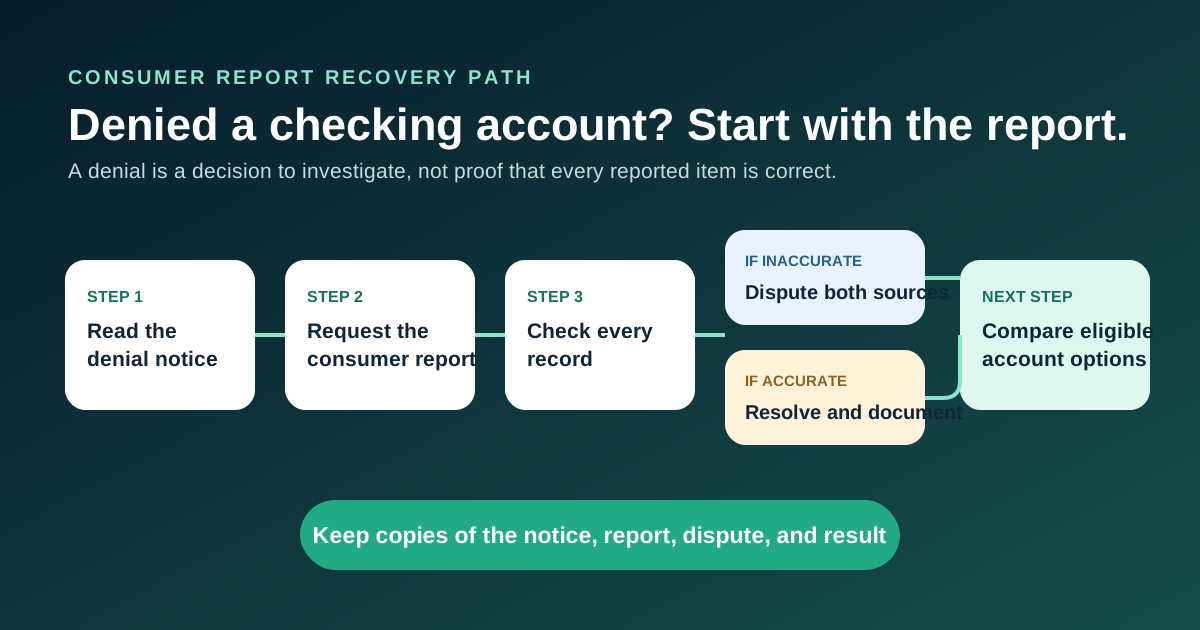
If an institution denies your checking-account application because of a consumer report, save the adverse-action notice, request the report from the named reporting company, review every identifying and account item, and dispute errors with both the reporting company and the institution that supplied the information. Accurate negative information generally cannot be removed merely because it is inconvenient, but you can compare second-chance accounts, lower-risk prepaid products, and other providers while resolving the record.
Step 1: read the adverse-action notice
The notice should identify the consumer reporting company whose report influenced the decision and explain your right to obtain a free copy and dispute inaccurate or incomplete information. The reporting company did not make the bank's approval decision. Keep the notice because it tells you which file to request.
Step 2: request the correct report
ChexSystems is one nationwide specialty consumer reporting company used for checking-account decisions, but it is not the only one. Request the report from every company named in the notice. Use the company's official request channel, verify the website address, and avoid paying a third party for access you can request directly.
Review names, addresses, identity details, account ownership, balances, dates, closure reasons, and whether the same event appears more than once. A record can be about unpaid balances, suspected fraud, account abuse, or other deposit-account history, so identify exactly what is being reported before responding.
Step 3: dispute errors with two parties
| Send to | Ask for | Include |
|---|---|---|
| Consumer reporting company | Reinvestigation of each inaccurate or incomplete item | Report item, concise explanation, identity proof, and supporting records |
| Furnisher | Investigation and corrected reporting | Account number, statements, payoff or closure proof, and the same itemized explanation |
Send copies, not irreplaceable originals. Keep the submission, delivery record, and all responses. A broad statement such as "this is wrong" is weaker than identifying the field, explaining the error, and attaching the record that supports the correction.
If the record is accurate
Ask the reporting company how long the item is eligible to remain and ask the furnisher what will be reported after payment or resolution. Do not accept a promise of deletion unless it is written and lawful. Paying a valid balance can change its status without erasing the historical event.
If identity theft is involved, use IdentityTheft.gov to create a recovery plan and include the identity-theft documentation in disputes. Do not combine an identity-theft claim with an ordinary billing disagreement.
Compare second-chance options by cost and controls
A second-chance account can provide a route back to ordinary banking, but the label does not guarantee a good deal. Compare:
- monthly fee and realistic waiver;
- minimum opening deposit and minimum balance;
- cash, check, and direct-deposit access;
- ATM network and out-of-network costs;
- whether checks, bill pay, and mobile deposit are included;
- overdraft policy and whether coverage can be declined; and
- the conditions and timeline for conversion to a standard account.
Use the Checking Account Cost Calculator rather than comparing monthly fees alone. Verify FDIC deposit insurance for a bank or NCUA share insurance for a federally insured credit union. For a prepaid product, confirm the specific insurance and registration conditions before loading money.
A practical decision path
- Notice names a reporting company: request that report before applying elsewhere.
- Report contains an error: dispute it with the reporting company and furnisher, then wait for the results.
- Report is accurate but unresolved: ask how resolution will be reported and compare second-chance products.
- No reporting company is named: ask the institution whether the decision was based on identity verification, policy, or another eligibility factor.
Once approved, use the checking account control guide to configure balances, holds, alerts, and insurance checks. Complete the overdraft audit before making the new account your primary bill account. The Banking Friction Report 2026 explains the larger access problem.
Frequently asked questions
Will checking my own ChexSystems report hurt a credit score?
Requesting your own specialty consumer report is not a credit application and does not reduce a credit score.
Can I force accurate information to be deleted?
Generally, dispute rights address information that is inaccurate or incomplete. Ask how a resolved balance will be updated, but do not assume accurate history must be deleted.
Should I apply at several banks immediately?
Usually it is more efficient to learn the denial reason and inspect the named report first. Repeated applications do not correct an inaccurate record and can create more administrative work.