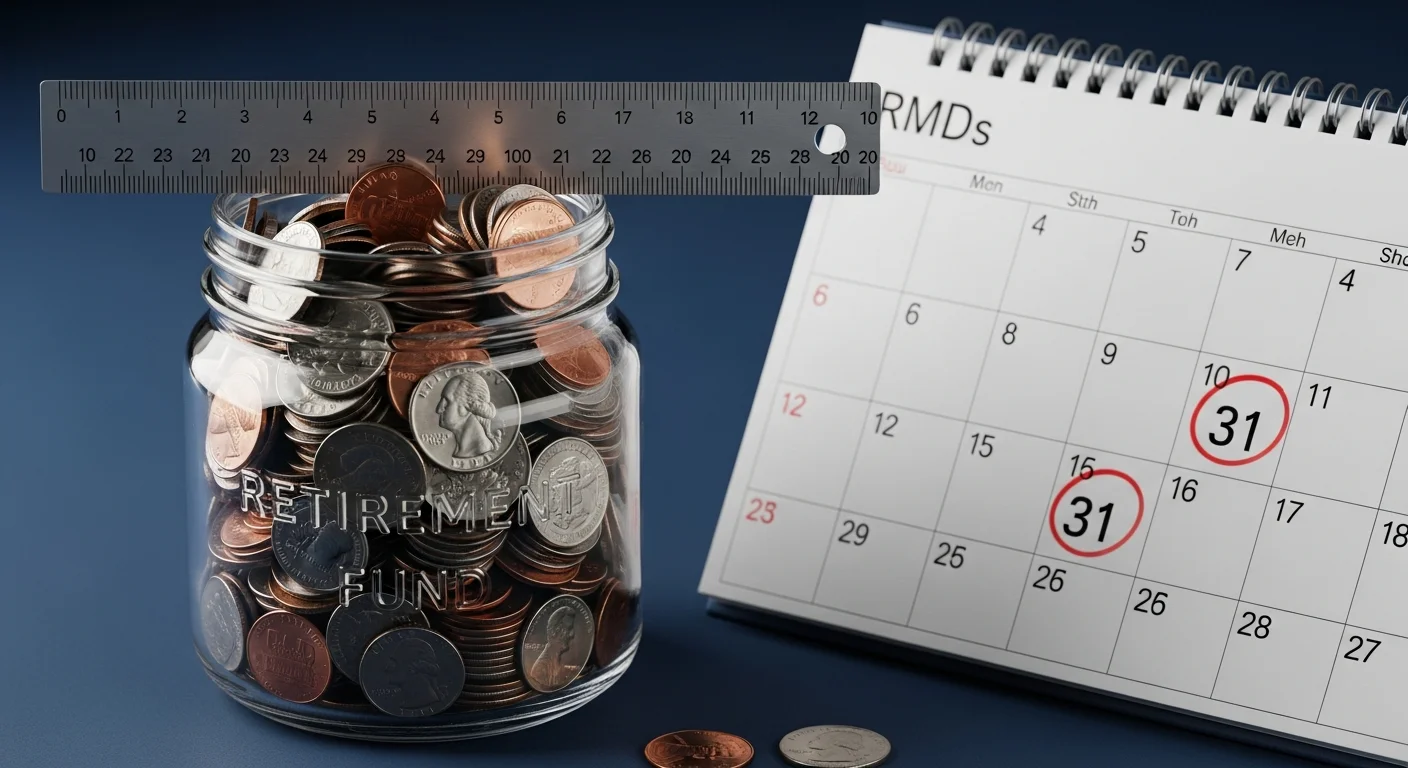
The IRS does not let you keep money in tax-deferred retirement accounts forever. Starting at age 73, thanks to the SECURE 2.0 Act, you must begin taking Required Minimum Distributions from your Traditional IRAs, 401(k)s, and other qualified retirement accounts. Miss the deadline and you face a steep 25% penalty on the amount you should have withdrawn. Understanding RMD rules, calculating your distribution correctly, and planning strategically can save you tens of thousands of dollars in unnecessary taxes.
Required Minimum Distributions exist because Congress gave you a tax break when you contributed to these accounts. The government wants its share eventually. RMDs ensure you start drawing down those accounts and paying income tax on the withdrawals during your lifetime rather than passing untaxed wealth to heirs indefinitely. According to Charles Schwab, RMDs affect an estimated 30 million Americans with tax-deferred retirement accounts, yet many retirees are caught off guard by the rules and the tax consequences.
Who Must Take RMDs
The age at which you must begin taking RMDs depends on when you were born. The SECURE 2.0 Act, signed into law in December 2022, raised the RMD age in two phases:
| Birth Year | RMD Starting Age | First RMD Deadline |
|---|---|---|
| 1950 or earlier | 72 (already required) | Already passed |
| 1951 - 1959 | 73 | April 1 of the year after turning 73 |
| 1960 or later | 75 | April 1 of the year after turning 75 |
If you were born between 1951 and 1959, your RMD age is 73. If you were born in 1960 or later, you get an extra two years and do not need to start until age 75. This change gives your retirement savings more time to grow tax-deferred, which can make a meaningful difference in your total retirement wealth.
Which Accounts Require RMDs
Not all retirement accounts are subject to RMDs. Understanding which accounts require distributions and which do not is critical for tax planning.
Accounts That Require RMDs
- Traditional IRA: The most common account subject to RMDs. All pre-tax and deductible contributions plus earnings are taxed as ordinary income upon withdrawal.
- SEP IRA: Simplified Employee Pension plans follow the same RMD rules as Traditional IRAs.
- SIMPLE IRA: Savings Incentive Match Plans for Employees also require RMDs starting at age 73.
- 401(k) plans: Employer-sponsored 401(k) accounts require RMDs, with one important exception for still-working participants discussed below.
- 403(b) plans: Tax-sheltered annuity plans for public school and nonprofit employees follow the same RMD requirements.
- 457(b) plans: Governmental deferred compensation plans are also subject to RMDs.
Accounts That Do NOT Require RMDs
- Roth IRAs: Roth IRAs have never required RMDs during the original owner's lifetime. Your money can continue growing tax-free for as long as you live.
- Roth 401(k)s: Under the SECURE 2.0 Act, designated Roth accounts in employer plans (Roth 401(k), Roth 403(b)) are no longer subject to RMDs starting in 2024. This is a significant change that eliminates the biggest disadvantage Roth 401(k)s had compared to Roth IRAs.
This distinction makes Roth accounts extremely valuable for retirees who want to maintain control over their taxable income. Money in Roth accounts grows tax-free and can stay invested indefinitely.
How to Calculate Your RMD
The RMD calculation itself is straightforward. You need two numbers:
RMD Formula: Your account balance as of December 31 of the prior year divided by the IRS Uniform Lifetime Table distribution period factor for your current age.
Step-by-Step Calculation
Step 1: Find your total account balance as of December 31 of the previous year. If you have multiple Traditional IRAs, add all balances together.
Step 2: Look up your distribution period in the IRS Uniform Lifetime Table (Table III in IRS Publication 590-B). This table provides a life expectancy factor based on your age.
Step 3: Divide the balance by the distribution period.
Example RMD Calculation for 2026
Suppose you turned 74 in 2026 and your combined Traditional IRA balance was $500,000 on December 31, 2025.
| Component | Value |
|---|---|
| Account balance (Dec 31, 2025) | $500,000 |
| Distribution period (age 74) | 25.5 |
| 2026 RMD amount | $19,608 |
Your 2026 RMD would be $500,000 divided by 25.5, which equals $19,608. This amount must be withdrawn by December 31, 2026, and will be taxed as ordinary income.
Key Distribution Period Factors
| Your Age | Distribution Period | Approximate % Withdrawn |
|---|---|---|
| 73 | 26.5 | 3.77% |
| 75 | 24.6 | 4.07% |
| 80 | 20.2 | 4.95% |
| 85 | 16.0 | 6.25% |
| 90 | 12.2 | 8.20% |
Notice that the percentage you must withdraw increases each year. By age 90, you are required to withdraw over 8% of your account annually. This is why early tax planning is so important.
If your spouse is more than 10 years younger and is the sole beneficiary, you use the Joint Life and Last Survivor Expectancy Table instead, which results in a smaller RMD.
Key Deadlines for 2026
Missing an RMD deadline triggers penalties, so knowing your dates is essential.
| Situation | Deadline | Important Notes |
|---|---|---|
| First RMD (year you turn 73) | April 1 of the following year | You get extra time for your very first RMD only |
| All subsequent annual RMDs | December 31 of each year | No extensions available |
| Turned 73 in 2025 | April 1, 2026 (first RMD) AND December 31, 2026 (second RMD) | Two RMDs in one year warning |
| Turning 73 in 2026 | April 1, 2027 (first RMD) | Can delay first RMD but consider the tax impact |
The Two-RMDs-in-One-Year Trap
This is one of the most costly mistakes retirees make. If you delay your first RMD to April 1 of the following year, you must also take your second RMD by December 31 of that same year. That means two full RMD amounts count as taxable income in a single year.
For example, if your RMD is approximately $20,000, delaying your first RMD means roughly $40,000 in taxable income from RMDs in one year instead of $20,000 spread across two years. This can push you into a higher tax bracket, trigger Medicare IRMAA surcharges, and increase the taxable portion of your Social Security benefits. In most cases, Fidelity recommends taking your first RMD in the year you turn 73 rather than delaying.
Penalties for Missing RMDs
The SECURE 2.0 Act made significant changes to RMD penalties, reducing them from previous levels but still making them substantial enough to demand attention.
Current Penalty Structure
- Standard penalty: 25% excise tax on the amount you should have withdrawn but did not. This was reduced from the previous 50% penalty under SECURE 2.0. On a $20,000 missed RMD, that is a $5,000 penalty.
- Reduced penalty for quick correction: If you correct the missed RMD within two years (by taking the distribution and filing a corrected tax return), the penalty drops to just 10%. On that same $20,000 missed RMD, that is a $2,000 penalty instead of $5,000.
- Possible full waiver: The IRS can waive the penalty entirely if you can show the shortfall was due to reasonable error and you are taking steps to remedy it. File IRS Form 5329 with a letter of explanation.
While the penalty reduction from 50% to 25% is welcome, a 25% excise tax on top of regular income tax makes missing an RMD extremely expensive. Prevention is far cheaper than correction.
5 Strategies to Minimize Your RMD Tax Hit
RMDs are taxed as ordinary income, which means they can push you into higher brackets, increase Medicare premiums, and reduce the value of your retirement savings. Here are five proven strategies to reduce the tax impact.
Strategy 1: Qualified Charitable Distributions (QCDs)
A Qualified Charitable Distribution allows you to transfer up to $111,000 in 2026 (up from $105,000 in 2025, indexed annually for inflation) directly from your IRA to a qualified charity. According to IRS guidelines, QCDs count toward satisfying your RMD but are excluded from your taxable income.
To qualify, you must be age 70 and a half or older, the distribution must go directly from your IRA custodian to the charity, and it must go to a qualifying 501(c)(3) organization.
Why this is powerful: If your RMD is $20,000 and you donate $15,000 via QCD, only $5,000 counts as taxable income. Compared to taking the full RMD and then donating from your bank account, a QCD saves you taxes because it never appears on your tax return as income.
Strategy 2: Roth Conversions Before RMD Age
One of the most effective long-term strategies is converting Traditional IRA money to a Roth IRA before you reach RMD age. You pay income tax on the conversion amount now, but once the money is in a Roth account, it grows tax-free, withdrawals are tax-free, and Roth IRAs have no RMDs.
The ideal window for Roth conversions is often between retirement and age 73, when your income may be lower. According to Schwab, converting during lower-income years allows you to pay taxes at a lower rate than you might face once RMDs begin stacking on top of Social Security.
Important: You cannot convert an RMD itself to a Roth. You must take your RMD first, then convert additional funds if desired. Plan conversions before RMDs begin for maximum benefit.
Strategy 3: Early Strategic Withdrawals
Rather than letting your tax-deferred accounts grow untouched until 73, consider making strategic withdrawals in your 60s to fill up lower tax brackets. If you retire at 62 and have little other income before Social Security starts, you can withdraw from your Traditional IRA at the 10% or 12% tax bracket, potentially much lower than the rate you would pay once RMDs, Social Security, and other income stack together.
This strategy effectively smooths your tax burden over more years instead of concentrating it when RMDs force large withdrawals. Work with a tax professional to model the optimal withdrawal amounts for your situation.
Strategy 4: The Still-Working Exception
If you are still working at age 73 or older and do not own more than 5% of the company, you can delay RMDs from your current employer's 401(k) plan until you actually retire. This exception applies only to your current employer's plan, not to IRAs or 401(k)s from previous employers.
According to Fidelity, this exception can be valuable if you plan to work past 73. Consider rolling old 401(k)s into your current employer's plan to consolidate and take advantage of this rule, but verify that your employer's plan accepts rollovers and allows the still-working exception.
Strategy 5: Aggregate IRA Withdrawals Strategically
If you have multiple Traditional IRAs, you must calculate the RMD for each account separately, but you can take the total RMD amount from any one or any combination of your IRAs. This gives you flexibility to choose which account to withdraw from based on investment performance, fees, or tax-lot considerations.
For example, if you have three IRAs with RMDs of $8,000, $5,000, and $7,000 respectively, your total RMD is $20,000. You can withdraw the entire $20,000 from whichever IRA is most advantageous, perhaps the one holding overweighted positions you want to trim or the one with the highest fees.
Note: This aggregation rule applies only to IRAs. You cannot aggregate RMDs across different account types. Each 401(k) and 403(b) RMD must be taken from that specific account.
RMD Impact on Other Taxes
RMDs do not just increase your income tax. They create a ripple effect across your entire tax picture that many retirees fail to anticipate.
Medicare IRMAA Surcharges
Medicare Part B and Part D premiums are income-based. If your Modified Adjusted Gross Income exceeds certain thresholds, you pay Income-Related Monthly Adjustment Amounts. In 2026, individuals with MAGI above $103,000 (or $206,000 for married filing jointly) face surcharges that can add hundreds or even thousands of dollars to annual Medicare premiums.
A large RMD can push you over an IRMAA threshold, costing you significantly more in Medicare premiums for the entire following year. According to The Motley Fool, planning your RMDs alongside IRMAA brackets is one of the most overlooked aspects of retirement tax planning.
Social Security Taxation
Up to 85% of your Social Security benefits can be taxed as income, and RMDs count toward the income calculation that determines how much is taxable. The thresholds are relatively low: combined income over $34,000 for individuals or $44,000 for married couples filing jointly means up to 85% of Social Security becomes taxable.
RMDs can easily push retirees over these thresholds, effectively increasing the tax rate on their Social Security benefits. Strategies like QCDs and Roth conversions before RMD age can help keep income below these trigger points.
Higher Tax Brackets
RMDs are taxed as ordinary income and stack on top of all your other income sources. If you receive $30,000 in Social Security, $15,000 in pension income, and a $25,000 RMD, your taxable income may push you from the 12% bracket into the 22% bracket. Each additional dollar of RMD above the bracket threshold is taxed at the higher rate.
This bracket creep is why proactive tax planning in the years before RMDs begin is so valuable. Filling lower brackets with strategic Roth conversions or withdrawals can dramatically reduce your lifetime tax burden.
Frequently Asked Questions About RMDs
What happens if I take more than my RMD?
You can always withdraw more than your RMD. There is no penalty for exceeding the minimum. However, the excess amount does not count toward future years' RMDs. All withdrawals from Traditional retirement accounts are taxed as ordinary income, so withdrawing more than necessary increases your current-year tax bill. Only take more if you need the funds or have a strategic reason.
Can I reinvest my RMD after taking it?
Yes. Once you withdraw your RMD, the money is yours to do with as you please. Many retirees who do not need the income for living expenses reinvest their RMD in a taxable brokerage account. While you lose the tax-deferred growth benefit, you can continue building wealth. Consider investing in tax-efficient funds like index funds or municipal bonds to minimize the ongoing tax drag in a taxable account.
Do inherited retirement accounts have RMD requirements?
Yes, but the rules changed significantly under the SECURE Act and SECURE 2.0. Most non-spouse beneficiaries who inherited accounts after 2019 must withdraw the entire balance within 10 years. The IRS has clarified that annual RMDs within that 10-year window are also required if the original owner had already begun taking RMDs. Spousal beneficiaries have more flexible options including treating the inherited account as their own. Consult IRS guidance on inherited accounts for your specific situation.
Are RMDs required from Roth 401(k) accounts?
No, not anymore. Before 2024, Roth 401(k) accounts were subject to RMDs even though Roth IRAs were not. The SECURE 2.0 Act eliminated RMDs for designated Roth accounts in employer plans effective 2024. This means Roth 401(k) and Roth 403(b) accounts now have the same no-RMD advantage as Roth IRAs, making them more valuable for tax-free growth and estate planning.
Can I take my RMD in installments throughout the year?
Yes. You do not have to withdraw your entire RMD in a lump sum. Many retirees set up monthly or quarterly distributions to create a steady income stream similar to a paycheck. This approach can also help with tax withholding since you can have federal and state taxes withheld from each distribution. Just make sure the total amount withdrawn by December 31 meets or exceeds your required minimum. Schwab and other custodians offer automatic RMD distribution services to help ensure you never miss a deadline.
Related Reading
- IRA vs 401(k): Which Retirement Account is Best for You in 2026? - Compare the key features of both retirement account types
- How Much Money Do You Need to Retire? - Calculate your retirement savings target
- Social Security Claiming Strategy Guide - Maximize your Social Security benefits alongside RMD planning
- Catch-Up Contribution Strategy for Over 50 - Boost retirement savings before RMDs begin
Disclaimer: This article is for informational purposes only and does not constitute financial, tax, or legal advice. RMD rules are complex and subject to change. Tax laws vary by state and individual circumstance. Consult with a qualified tax professional or financial advisor before making decisions about your required minimum distributions, Roth conversions, or charitable giving strategies. The information presented here reflects rules and limits as understood for the 2026 tax year based on current IRS guidance.