Your employer is literally offering you free money, and you might be leaving it on the table. The 401(k) employer match is the closest thing to guaranteed returns you will ever find in investing, yet 25% of employees do not contribute enough to get the full match. Here is everything you need to know to maximize this incredible benefit.
A 401(k) is an employer-sponsored retirement account that lets you save pre-tax money from your paycheck. Many employers sweeten the deal by matching a portion of your contributions, essentially paying you extra money to save for retirement.
Understanding the Employer Match
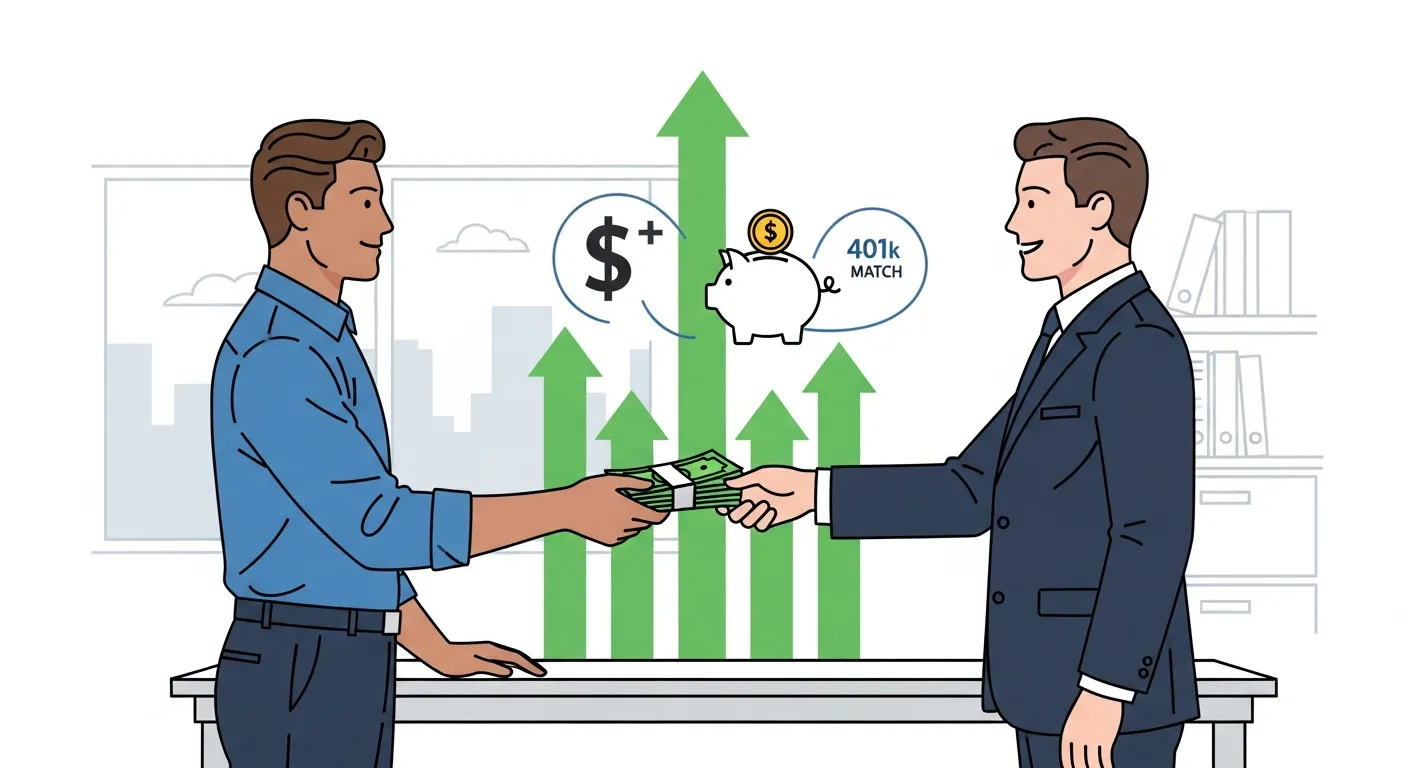
An employer match means your company contributes additional money to your 401(k) based on how much you contribute. This is on top of your salary and costs you nothing extra.
Common Match Formulas:
- Dollar-for-dollar up to X%: If you contribute 6% of your salary, your employer adds another 6%. This is the most generous common formula.
- 50 cents on the dollar up to X%: If you contribute 6%, your employer adds 3%.
- Tiered match: 100% match on first 3%, then 50% match on next 2%.
- Discretionary match: Employer decides each year based on company performance.
Real Dollar Example
Let us say you earn $60,000 and your employer offers a 100% match on contributions up to 6% of your salary:
- 6% of $60,000 = $3,600 you contribute
- 100% match = $3,600 employer contributes
- Total annual contribution = $7,200
- Your cost = $3,600 (but actually less because of tax savings)
- Your gain = $3,600 in free money
That is an instant 100% return on your contribution, before any investment gains. No other investment offers guaranteed returns like this.
2026 401(k) Contribution Limits
- Employee contribution limit: $24,500
- Catch-up contribution (age 50+): Additional $8,000
- Total limit (employee + employer): $72,000
These limits apply to all your 401(k) contributions across all employers if you have multiple jobs.
Why the Match Matters So Much
Consider two employees who both earn $60,000:
Employee A: Contributes 3% ($1,800), gets partial match of $1,800
Employee B: Contributes 6% ($3,600), gets full match of $3,600
Over 30 years at 7% average returns:
- Employee A accumulates: $339,000
- Employee B accumulates: $678,000
Employee B invested just $54,000 more of their own money over 30 years but ended up with $339,000 more in retirement. That is the power of the employer match combined with compound growth.
Step-by-Step: How to Maximize Your Match
Step 1: Find Your Match Formula
Check your benefits documents, HR portal, or ask HR directly. You need to know the exact match percentage and any caps.
Step 2: Calculate the Minimum Contribution
If your employer matches 100% up to 6%, you need to contribute at least 6% to capture the full match. Contributing 4% or 5% leaves money on the table.
Step 3: Adjust Your Contribution
Log into your 401(k) provider's website or HR system and set your contribution percentage. Most changes take effect within 1-2 pay periods.
Step 4: Verify the Match Appears
After a few pay periods, check your 401(k) statement to confirm the employer match is being deposited alongside your contributions.
Understanding Vesting Schedules
Here is the catch: employer match money often comes with a vesting schedule. This means you do not fully own the matched funds until you have worked at the company for a certain period.
Common Vesting Schedules:
- Immediate vesting: You own 100% of match money right away (best case)
- Cliff vesting: 0% vested until a specific date (often 3 years), then 100%
- Graded vesting: Gradual increase (20% after year 1, 40% after year 2, etc.)
Your own contributions are always 100% vested immediately. Only the employer match has vesting restrictions.
If you leave before fully vesting, you forfeit the unvested portion of the match. This is why vesting schedules matter when considering job changes.
How Much Should You Contribute? Income-Based Recommendations
Financial experts generally recommend saving 15% of your gross income for retirement, including the employer match. Here is how to think about your contribution level based on your income:
| Gross Income | Minimum (Get Full Match) | Recommended | Aggressive Saver |
|---|---|---|---|
| $40,000 | 6% ($2,400/yr) | 10% ($4,000/yr) | 15% ($6,000/yr) |
| $60,000 | 6% ($3,600/yr) | 12% ($7,200/yr) | 15-20% ($9,000-$12,000/yr) |
| $80,000 | 6% ($4,800/yr) | 15% ($12,000/yr) | 20%+ ($16,000+/yr) |
| $100,000 | 6% ($6,000/yr) | 15% ($15,000/yr) | Max ($24,500/yr) |
| $150,000+ | 6% ($9,000/yr) | 15% ($22,500/yr) | Max + catch-up if 50+ |
According to Fidelity's retirement guidelines, you should aim to have 1x your salary saved by age 30, 3x by age 40, 6x by age 50, and 10x by age 67. If you started late, you may need to contribute more aggressively to catch up.
If you are starting late, the 2026 catch-up contribution of $8,000 for workers age 50 and older brings the total possible employee contribution to $32,500 per year. That additional savings capacity can make a significant difference over 15-17 years before retirement.
Beyond the Match: The Optimal Savings Order
Once you are getting the full employer match, consider these next steps in this priority order:
- Max out a Roth IRA: $7,500/year limit ($8,600 if 50+) with tax-free growth. Roth IRAs typically offer better fund choices and more flexibility than most 401(k) plans.
- Return to 401(k): Increase contributions toward the $24,500 limit. Pre-tax contributions reduce your current taxable income.
- HSA if eligible: Triple tax advantage for healthcare savings. The 2026 limits are $4,400 for self-only coverage and $8,750 for family coverage.
- Taxable brokerage account: After maxing tax-advantaged accounts, invest additional savings in low-cost index funds.
The order matters because each step prioritizes the highest tax advantage first. However, if your 401(k) has excellent low-cost index funds (expense ratios below 0.10%), maximizing the 401(k) before the Roth IRA can also be a sound approach.
401(k) Investment Options: Choosing Your Funds
Most 401(k) plans offer 15-30 investment options. Here is how to evaluate them:
Target Date Funds
If your plan offers target date funds with low expense ratios (under 0.20%), this is the simplest and most effective choice for most investors. Pick the fund closest to your expected retirement year (e.g., "Target 2060" if you plan to retire around 2060). These funds automatically shift from stocks to bonds as you approach retirement.
Index Fund Options
If you prefer more control, look for these core building blocks in your plan:
- S&P 500 or Total Stock Market Index: Your US equity foundation. Look for expense ratios under 0.05%.
- International Stock Index: Provides global diversification. Aim for expense ratios under 0.15%.
- Bond Index: Adds stability and reduces volatility. Look for expense ratios under 0.10%.
What to Avoid in Your 401(k)
- Actively managed funds with expense ratios above 0.50%: These rarely outperform their index counterparts over long periods. The S&P SPIVA Scorecard consistently shows that the majority of active managers underperform their benchmarks.
- Company stock: Holding too much of your employer's stock concentrates risk. If the company struggles, you could lose both your job and your savings simultaneously. Keep company stock below 10% of your portfolio.
- Stable value funds as your only holding: While safe, these funds typically return 2-3% annually, which barely keeps pace with inflation. They are appropriate for a small allocation near retirement, not as your primary investment.
Common Mistakes to Avoid
- Not contributing at all: 100% of the match is left on the table. According to the Bureau of Labor Statistics, about one-third of workers with access to a 401(k) do not participate.
- Contributing below the match threshold: Partial capture of free money. Even 1% below the match threshold could mean losing $500-$1,500 per year in employer contributions.
- Not increasing contributions with raises: When you get a raise, increase your 401(k) contribution by at least half the raise amount. This builds wealth without reducing your current take-home pay.
- Ignoring vesting when job hunting: If you are 80% vested with cliff vesting at year 3, staying a few more months could mean keeping thousands in employer match money.
- Cashing out when changing jobs: Taking a lump-sum distribution triggers income taxes plus a 10% early withdrawal penalty if under age 59 1/2. On a $50,000 balance, that could mean losing $15,000 or more. Always roll over to your new employer's plan or an IRA.
- Not naming beneficiaries: Without proper beneficiary designations, your 401(k) may go through probate and potentially to someone you did not intend.
What If You Cannot Afford the Full Match?
If contributing 6% feels impossible, start with 1% and increase by 1% every six months. Many 401(k) plans have auto-escalation features that do this automatically. Within 3 years you will be at the full match level without ever feeling a dramatic reduction in take-home pay.
Also consider: if you are not contributing to the match but have other savings, redirect those funds. The guaranteed 50-100% return from the match beats any savings account or most investments. Even reducing contributions to a non-matched savings account to fund your 401(k) match is a mathematically superior move.
The Bottom Line
The 401(k) employer match is the single best deal in personal finance. It is free money, tax-advantaged, and compounds over decades into significant wealth. Before optimizing anything else in your financial life, make sure you are capturing every dollar of your employer match.
Check your contribution level today. If you are not getting the full match, increase your contribution this week. If you are getting the full match, consider whether you can contribute more toward the $24,500 annual limit. Your future self will thank you.
For a complete comparison of retirement accounts, read our IRA vs 401(k) guide. And for a comprehensive roadmap to retirement readiness, see our complete retirement planning guide.
Frequently Asked Questions
What is a 401(k) employer match and how does it work?
A 401(k) employer match is free money your company adds to your retirement account based on your own contributions. The most common formula is a dollar-for-dollar match up to a certain percentage of your salary, or 50 cents on the dollar up to a percentage. For example, if your employer matches 100% of contributions up to 6% and you earn $60,000, contributing at least $3,600 per year (6%) means your employer adds another $3,600. That is an instant 100% return on your money before any market gains. Always contribute at least enough to capture the full match.
What are the 401(k) contribution limits for 2026?
For 2026, the employee contribution limit is $24,500 for workers under age 50. If you are 50 or older, you can contribute an additional $8,000 in catch-up contributions, bringing your total to $32,500. Workers aged 60-63 qualify for an enhanced catch-up of $11,250 under the SECURE 2.0 Act, bringing their total to $34,750. The combined employee plus employer contribution limit is $72,000 (or $80,000 with standard catch-up). These limits apply across all 401(k) accounts if you have more than one employer plan.
What happens to my 401(k) when I leave my job?
When you leave a job, you have four options for your 401(k): leave it with your former employer (if allowed), roll it over to your new employer's plan, roll it into an IRA, or cash it out. Rolling into an IRA typically offers the most investment flexibility and lowest fees. Cashing out triggers income taxes plus a 10% early withdrawal penalty if you are under 59 and a half, which can consume 30-40% of your balance. Your vested employer contributions transfer with you, but unvested amounts are forfeited. Check your vesting schedule before leaving to understand what portion of the match you keep.
Should I contribute to my 401(k) or pay off debt first?
Always contribute enough to get the full employer match first, regardless of your debt situation. The match provides an instant 50-100% return that outpaces even high-interest credit card debt. After capturing the match, prioritize paying off high-interest debt (above 7-8% APR) before making additional 401(k) contributions beyond the match. Once high-interest debt is eliminated, increase your 401(k) contributions toward the $24,500 annual limit. For low-interest debt like a mortgage (3-5%), it generally makes sense to keep contributing to your 401(k) rather than making extra payments.
What is the difference between a Roth 401(k) and a Traditional 401(k)?
A Traditional 401(k) uses pre-tax dollars, reducing your taxable income now but requiring you to pay income taxes on withdrawals in retirement. A Roth 401(k) uses after-tax dollars, providing no immediate tax break but allowing completely tax-free withdrawals in retirement including all investment gains. If you expect your tax rate to be higher in retirement than it is now, the Roth option is generally better. Younger workers in lower tax brackets often benefit more from Roth contributions, while higher earners closer to retirement may prefer the Traditional option. Many financial planners recommend splitting contributions between both to create tax diversification in retirement.
Can I withdraw from my 401(k) before age 59 and a half?
Early withdrawals from a 401(k) before age 59 and a half are subject to regular income tax plus a 10% early withdrawal penalty. Some exceptions include the Rule of 55 (penalty-free withdrawals if you leave your job at age 55 or older), substantially equal periodic payments (SEPP/72t distributions), qualifying hardship withdrawals for medical expenses or preventing eviction, and 401(k) loans where you borrow from your own account and repay with interest. However, early withdrawals should be a last resort because they permanently reduce your retirement savings and the compounding growth those funds would have generated.
Update log
July 16, 2026: Updated 2026 retirement-account limits and related income thresholds against the IRS annual adjustment. A second full-page verification corrected the savings-order IRA and HSA values that remained stale after the initial update.
Frequently Asked Questions
What is a 401(k) employer match and how does it work?
What are the 401(k) contribution limits for 2026?
What happens to my 401(k) when I leave my job?
Should I contribute to my 401(k) or pay off debt first?
What is the difference between a Roth 401(k) and a Traditional 401(k)?
Can I withdraw from my 401(k) before age 59 and a half?
Put the guide into practice