
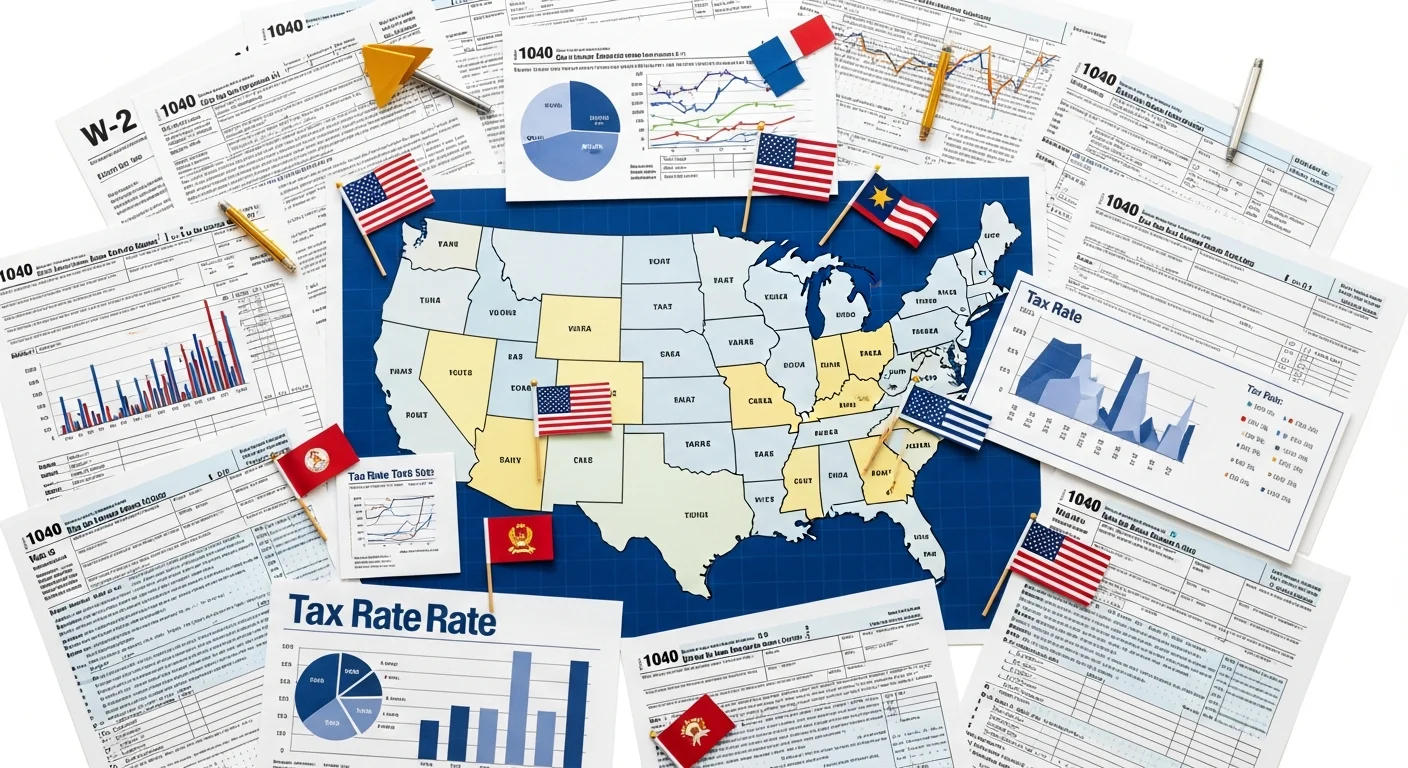
Most investors focus on federal capital gains rates and forget that their state can add another 0% to 13.3% on top. A California investor paying the 15% federal rate on a $500,000 capital gain also pays California's top rate of 13.3%, bringing the total to 28.3%. That is $141,500 versus $75,000 for the same gain in a no-tax state like Texas. State capital gains taxes are one of the most significant and controllable variables in long-term investment planning.
State tax laws change frequently. The rates below reflect best available information for 2026 but should be verified with each state's department of revenue or a qualified tax professional before filing. This article is for educational purposes only and does not constitute tax advice.
Quick Answer
Eight states have no broad individual income tax; Washington is discussed separately because it imposes a capital-gains tax: Alaska, Florida, Nevada, New Hampshire, South Dakota, Tennessee, Texas, Wyoming, and Washington (on gains below $262,000 for single filers). California taxes capital gains at ordinary income rates up to 13.3%, the highest in the nation. Most other states tax capital gains at their ordinary income rate, ranging from roughly 2.5% to 10.75%. Only a handful of states offer a preferential rate for long-term capital gains.
Key Takeaways
- 01Most states offer no preferential rate for long-term gains. Unlike federal law, which taxes long-term gains at 0%, 15%, or 20%, the majority of states tax capital gains at the same rate as ordinary income. The federal preference does not automatically translate to state tax savings.
- 02State taxes can exceed federal taxes for some investors. A high earner in California, New Jersey, or New York can pay more in state capital gains tax alone than lower-income investors pay federally. Combined federal plus state rates in these states can exceed 40% for top earners.
- 03Relocating has real tax consequences, but residency rules are strict. Moving from California to Nevada before a large asset sale can save hundreds of thousands in taxes. But California aggressively audits high-income taxpayers who claim to have moved, and establishing genuine domicile requires more than just a Nevada address.
- 04Washington state's capital gains tax is narrow but real. Washington applies a 7% rate to the first $1 million of taxable Washington capital gains and 9.9% above $1 million; the annual standard deduction is applied before these tiers. (as of 2026 inflation adjustments), upheld by the state Supreme Court in 2023. It applies to long-term gains on equities and some other assets but exempts real estate.
- 05A handful of states have partial capital gains exclusions. Montana, New Mexico, and a few others allow partial exclusions for long-term capital gains. Massachusetts taxes short-term gains at a higher rate than long-term gains, one of the few states with any preferential treatment at all.
Key Definitions
- State Capital Gains Tax
- A state-level tax on profits from the sale of capital assets. Most states impose this tax as part of their general income tax, applying the state's ordinary income rate to capital gains with no preferential rate.
- Domicile
- Your permanent legal home, the state where you intend to remain indefinitely. State income and capital gains taxes are typically owed to your state of domicile, regardless of where an asset transaction is executed.
- Residency Audit
- An examination by a state tax authority to verify that a taxpayer claiming to have moved out of the state actually established genuine domicile elsewhere. High-tax states, particularly California and New York, aggressively audit high-income taxpayers who claim to have relocated.
- Local Capital Gains Tax
- In some jurisdictions, cities or counties impose their own income or capital gains taxes in addition to state taxes. New York City residents pay city income tax of up to 3.876% on top of New York State tax, for a combined state+city rate of up to 14.776%.
Table of Contents
- 1. How States Tax Capital Gains
- 2. States With Zero Capital Gains Tax
- 3. Highest Capital Gains Tax States
- 4. States with Capital Gains Preferences
- 5. All 50 States + D.C.: Complete Table
- 6. State Rankings: Highest to Lowest
- 7. Combined Federal + State Rate Examples
- 8. Relocating for Tax Purposes: What It Really Takes
- 9. Worked Examples by State
- 10. Common Mistakes
- 11. Frequently Asked Questions
- 12. Sources and References
How States Tax Capital Gains
States approach capital gains taxation in three distinct ways:
1. No income tax (zero capital gains tax): Eight states have no broad individual income tax and therefore charge no capital gains tax: Alaska, Florida, Nevada, New Hampshire, South Dakota, Tennessee, Texas, Wyoming, Washington is treated separately because it has a separate capital-gains tax. Investors in these states pay only federal capital gains tax.
2. Capital gains taxed as ordinary income (most states): The majority of states with income taxes treat capital gains the same as wages, applying the state's regular income tax rate. There is no preferential rate for long-term gains at the state level. If your state has a 5% income tax rate, your long-term capital gains are also taxed at 5%.
3. Partial exclusion or preferential rate (a few states): A small number of states offer some form of capital gains tax preference: a partial exclusion of the gain, a lower flat rate on capital gains, or a differentiation between short-term and long-term gains. Massachusetts (5% long-term vs. 8.5% short-term), Montana (partial exclusion), and a few others fall into this category.
States With Zero Capital Gains Tax
| State | Capital Gains Rate | Notes |
|---|---|---|
| Alaska | 0% | No state income tax |
| Florida | 0% | No state income tax; popular retirement destination |
| Nevada | 0% | No state income tax; popular for California relocation |
| New Hampshire | 0% | Eliminated interest and dividend income tax fully as of 2025 |
| South Dakota | 0% | No state income tax |
| Tennessee | 0% | Eliminated income tax; previously taxed dividends and interest only |
| Texas | 0% | No state income tax; largest no-tax state by population |
| Wyoming | 0% | No state income tax |
| Washington | 0% / 7% | A 7% tax can apply to Washington long-term capital gains after the state deduction and exemptions; the Department of Revenue adjusts the deduction and the current-year amount must be verified |
Highest Capital Gains Tax States
| State | Top Capital Gains Rate | Notes |
|---|---|---|
| California | Up to 13.3% | Highest in the nation; no preferential rate for any capital gains |
| New Jersey | Up to 10.75% | Top rate on income over $1 million |
| Washington D.C. | Up to 10.75% | D.C. income tax applies to capital gains |
| New York | Up to 10.9% | State rate only; NYC residents add up to 3.876% city income tax |
| Hawaii | Up to 11% | High graduated rate; no capital gains preference |
| Oregon | Up to 9.9% | No preferential rate; additional Portland Metro tax may apply |
| Minnesota | Up to 9.85% | No preferential rate for capital gains |
| Vermont | Up to 8.75% | No preferential rate; short-term gains taxed as ordinary income |
| Iowa | Up to 8.53% | Rate reduced significantly in recent years; verify current rate |
| Wisconsin | Up to 7.65% | Eliminated long-term capital gains exclusion in recent years |
States With Capital Gains Tax Preferences
A small number of states offer preferential treatment for capital gains that reduces the tax below the regular income rate:
| State | Preference Type | Details |
|---|---|---|
| Massachusetts | Rate differentiation | Long-term gains (held 1+ year): 5%. Short-term gains: 8.5% |
| Montana | Partial exclusion | Historically allowed partial capital gains exclusion; verify current status |
| New Mexico | Partial exclusion | Partial deduction for certain long-term capital gains on New Mexico investments |
| North Dakota | Low flat rate | Top rate reduced to approximately 2.5%; low effective capital gains tax burden |
| Arizona | Flat rate | Flat 2.5% income tax rate applies to all income including capital gains |
All 50 States + Washington D.C.: Complete Rate Table
Rates below represent the maximum state capital gains tax rate for 2026. Most states tax capital gains at the same rate as ordinary income. Rates are approximate and should be verified with your state's department of revenue before filing.
| State | Max Rate | Notes |
|---|---|---|
| Alabama | 5.0% | Flat 5% on income over threshold |
| Alaska | 0% | No state income tax |
| Arizona | 2.5% | Flat 2.5% income tax (as of 2023) |
| Arkansas | 4.7% | Rate reduced in recent years; verify current rate |
| California | 13.3% | Highest in nation; no preferential LTCG rate |
| Colorado | 4.4% | Flat income tax rate |
| Connecticut | 6.99% | Top graduated rate |
| Delaware | 6.6% | Top graduated rate |
| Florida | 0% | No state income tax |
| Georgia | 5.39% | Rate reducing; verify 2026 rate |
| Hawaii | 11.0% | Second highest; no LTCG preference |
| Idaho | 5.8% | Flat rate as of recent reform |
| Illinois | 4.95% | Flat income tax rate |
| Indiana | 3.05% | Flat rate; reduced in recent years |
| Iowa | 8.53% | Rate schedule reducing through 2026; verify current |
| Kansas | 5.7% | Top graduated rate |
| Kentucky | 4.0% | Flat rate (reduced from 3.99%) |
| Louisiana | 4.25% | Top graduated rate; verify current rate |
| Maine | 7.15% | Top graduated rate |
| Maryland | 5.75% | State rate; additional county/city taxes apply (up to ~3.2%) |
| Massachusetts | 5.0% | Long-term gains 5%; short-term gains 8.5% (one of few state preferences) |
| Michigan | 4.25% | Flat income tax rate |
| Minnesota | 9.85% | Top graduated rate; no LTCG preference |
| Mississippi | 4.7% | Flat rate (reducing to 4% eventually) |
| Missouri | 4.8% | Top rate reduced; verify current rate |
| Montana | 6.75% | Partial LTCG exclusion may apply; verify current rules |
| Nebraska | 6.64% | Rate reducing; verify 2026 rate |
| Nevada | 0% | No state income tax |
| New Hampshire | 0% | No income tax as of 2025 |
| New Jersey | 10.75% | Top rate on income over $1 million |
| New Mexico | 5.9% | Partial exclusion for some LTCG; verify current rules |
| New York | 10.9% | State rate; NYC residents add up to 3.876% city tax (combined up to 14.776%) |
| North Carolina | 3.99% | Flat rate; reducing further by 2030 |
| North Dakota | 2.5% | One of the lowest rates in the nation |
| Ohio | 3.5% | Rate reduced in recent years; top graduated rate |
| Oklahoma | 4.75% | Top graduated rate |
| Oregon | 9.9% | No LTCG preference; Portland Metro area additional surcharge may apply |
| Pennsylvania | 3.07% | Flat rate; one of the lowest for a high-population state |
| Rhode Island | 5.99% | Top graduated rate |
| South Carolina | 6.4% | Rate reduced from 7%; verify current rate |
| South Dakota | 0% | No state income tax |
| Tennessee | 0% | No state income tax |
| Texas | 0% | No state income tax |
| Utah | 4.65% | Flat rate |
| Vermont | 8.75% | Top graduated rate; no LTCG preference |
| Virginia | 5.75% | Top graduated rate (applied to income above $17,000) |
| Washington | 7.0% | 7% on long-term capital gains above ~$262,000 threshold; real estate exempt |
| West Virginia | 6.5% | Top graduated rate; rate reductions in progress |
| Wisconsin | 7.65% | Top rate; long-term exclusion eliminated in recent legislation |
| Wyoming | 0% | No state income tax |
| Washington D.C. | 10.75% | D.C. income tax applies to all capital gains |
State Rankings: Capital Gains Tax Burden Summary
Lowest Burden (0%)
- Alaska
- Florida
- Nevada
- New Hampshire
- South Dakota
- Tennessee
- Texas
- Wyoming
Low to Moderate (2.5-5%)
- North Dakota (2.5%)
- Arizona (2.5%)
- Indiana (3.05%)
- Pennsylvania (3.07%)
- Ohio (3.5%)
- Kentucky (4.0%)
- Utah (4.65%)
- Massachusetts (5%)
Highest Burden (7%+)
- California (13.3%)
- Hawaii (11%)
- New Jersey (10.75%)
- Washington D.C. (10.75%)
- New York (10.9%)
- Oregon (9.9%)
- Minnesota (9.85%)
- Vermont (8.75%)
Combined Federal + State Capital Gains Rates: Real Examples
| Investor Profile (15% federal LTCG bracket) | State | State Rate | Combined Rate | Tax on $100,000 Gain |
|---|---|---|---|---|
| Same investor, different state | Texas | 0% | 15% | $15,000 |
| Same investor, different state | Pennsylvania | 3.07% | 18.07% | $18,070 |
| Same investor, different state | Colorado | 4.4% | 19.4% | $19,400 |
| Same investor, different state | Virginia | 5.75% | 20.75% | $20,750 |
| Same investor, different state | Oregon | 9.9% | 24.9% | $24,900 |
| Same investor, different state | California | 13.3% | 28.3% | $28,300 |
Same $100,000 long-term capital gain, same 15% federal rate. The state of residence alone creates an $13,300 difference in total tax paid.
Relocating for Tax Purposes: What It Actually Takes
Moving from California to Nevada before selling a $2 million stock position could save $266,000 in state capital gains taxes. The math is compelling. The execution is complicated.
You must establish genuine domicile in the new state. Domicile is more than a mailing address. It is your permanent legal home. Courts and state tax authorities examine the "center of your life" test: where you spend the most time, where your family lives, where your social and professional ties are, where your primary bank accounts are, where you vote, where your car is registered.
California is particularly aggressive in this regard. The California Franchise Tax Board (FTB) audits high-income taxpayers who claim to have left the state. If California determines you maintained California domicile (or spent California does not generally use a simple 546-day residency test. A separate 546-consecutive-day safe harbor may apply to certain employment-related absences when all requirements are satisfied. residency and attempt to collect the full tax.
What California actually looks at in a residency audit:
- •Number of days spent in California vs. the new state (tracked via credit card records, phone location data, flight records)
- •Location of your closest personal connections (spouse, children, doctors, friends)
- •Where your professional licenses and club memberships are held
- •Where you filed for homestead exemption on real property
- •Where your primary bank account and investment accounts are held
New York applies similar scrutiny. The statutory residency rule means that even if you claim another state as domicile, New York can tax you as a resident if you maintain a permanent place of abode in New York and spend more than 183 days per year in the state.
Practical timeline: Tax experts typically recommend establishing the new state residency at least 12-18 months before a major liquidity event (large stock sale, business sale, large property sale). The relocation must be genuine, documented, and complete. Filing change of address with the post office, getting a new driver's license, and registering to vote in the new state are baseline steps, not sufficient on their own for high-income taxpayers.
Worked Examples by State
Example 1: California vs. Nevada (Large Stock Sale)
- Investor sells $1,000,000 of long-term appreciated stock (cost basis: $100,000). Long-term gain: $900,000
- Federal LTCG (20% rate, income over $545,500): $900,000 x 20% = $180,000
- Federal NIIT (3.8%): $900,000 x 3.8% = $34,200
- California state tax (13.3%): $900,000 x 13.3% = $119,700
- Total in California: $180,000 + $34,200 + $119,700 = $333,900
- Same gain in Nevada (no state tax): $180,000 + $34,200 = $214,200
- State tax difference: $119,700
Example 2: New York City Resident (State + City Tax)
- NYC resident sells long-term stock for a $150,000 gain in the 15% federal bracket
- Federal LTCG (15%): $150,000 x 15% = $22,500
- New York State (8.82% for this income level): $150,000 x 8.82% = $13,230
- New York City (3.876%): $150,000 x 3.876% = $5,814
- Total: $22,500 + $13,230 + $5,814 = $41,544 (27.7% combined rate)
- Same gain in Texas: $22,500 federal only (15% effective rate)
- State + city cost of living in New York: +$19,044 on this single transaction
Example 3: Washington State's Narrow Capital Gains Tax
- Washington resident (no income tax state) sells ETF portfolio. Long-term gain: $350,000
- Washington capital gains tax threshold (2026): ~$262,000
- Taxable amount above threshold: $350,000 - $262,000 = $88,000
- Washington capital gains tax at 7%: $88,000 x 7% = $6,160
- Federal LTCG (20% rate, income over threshold): $350,000 x 20% = $70,000
- Federal NIIT: $350,000 x 3.8% = $13,300
- Total: $70,000 + $13,300 + $6,160 = $89,460
- Note: Real estate sales are exempt from Washington's capital gains tax, so a $350,000 gain on real estate would only owe federal taxes
Common Mistakes with State Capital Gains Taxes
1. Assuming the Federal 0% Rate Means Zero State Tax
The 0% federal long-term capital gains rate does not apply at the state level in most states. A California investor who qualifies for the 0% federal rate on a $40,000 long-term gain still pays California income tax at their marginal rate, which could be 9.3% or more. Always calculate the state tax separately.
2. Moving Without Understanding Residency Rules
Claiming to have moved to a low-tax state while continuing to spend most of your time in a high-tax state is one of the most common triggers for a state income tax audit. The relocation must be genuine. States have sophisticated tracking tools and routinely audit high-income taxpayers who claim to have moved immediately before a large capital event.
3. Ignoring Local Taxes
Some jurisdictions impose local income taxes on top of state taxes. New York City adds up to 3.876% city tax. Some Maryland counties impose local taxes of up to approximately 3.2% on top of the state rate. Philadelphia has a wage and earnings tax. Always check whether your city or county imposes additional taxes.
4. Not Accounting for Multi-State Situations
If you sell an asset while living in one state but have income from another state, multi-state tax filing becomes complex. Capital gains are generally taxed by your state of domicile, but some states may assert partial taxation if the asset has connections to that state. Remote workers who moved during the year may owe taxes to two states in the same year.
5. Timing a Sale in the Wrong Calendar Year During a Move
If you are in the process of establishing residency in a new state, the year of your move is the most complex tax year. Most states use domicile as of December 31 of the tax year, but some prorate based on the number of days you were a resident. Selling a large appreciated position in the year you move requires careful planning with a tax advisor who understands both states' rules.
Frequently Asked Questions About State Capital Gains Tax
Which states have no capital gains tax?
Eight states have no state income tax and therefore no capital gains tax at all: Alaska, Florida, Nevada, New Hampshire, South Dakota, Tennessee, Texas, and Wyoming. Washington state has no income tax but imposes a 7% capital gains tax on long-term gains above the annual Washington deduction published by the Department of Revenue (with real estate exempt). New Hampshire phased out its remaining income tax on interest and dividends as of 2025.
Does California have a preferential capital gains rate?
No. California is one of the only states that explicitly prohibits a preferential capital gains rate by its state constitution. All capital gains, short-term and long-term, are taxed at California's ordinary income rate, which reaches 13.3% at the highest income level. This is the highest state capital gains rate in the nation.
Does moving to Florida before selling stock really save on taxes?
Yes, if the move is genuine and timely. Florida has no state income tax. A California resident who establishes genuine Florida domicile before selling appreciated stock avoids California's capital gains tax entirely. The key word is "genuine": you must actually live in Florida, have your primary home there, and meet the domicile test. A vacation home in Florida while your family remains in California is not sufficient domicile.
Are capital gains taxed differently for part-year residents?
This varies by state. Most states require part-year residents to allocate income between the periods of residency in each state. Capital gains realized while you were a resident of the state are typically taxable. Capital gains realized after you established residency in a new state are typically not taxable by the old state (with some exceptions). The year of a move requires careful tracking of which gains were realized during which residency period.
What is Washington state's capital gains tax?
Washington state enacted a 7% capital gains tax effective 2022, applicable to long-term capital gains above an annual threshold (the annual Washington deduction published by the Department of Revenue as adjusted for inflation in 2026). The tax applies to gains from the sale of stocks, bonds, and other capital assets but exempts real estate sales. It was challenged as unconstitutional but upheld by the Washington Supreme Court in 2023. It applies only to gains above the threshold; gains below the threshold are not taxed.
Can I deduct state capital gains taxes on my federal return?
State taxes paid may be deductible as itemized deductions on Schedule A under the SALT (State and Local Taxes) deduction. However, the SALT deduction is currently capped at $10,000 per year for most taxpayers ($5,000 for married filing separately) through the provisions of the Tax Cuts and Jobs Act. For investors paying large state capital gains taxes, this cap significantly limits the federal deductibility of those payments.
Does Massachusetts tax long-term capital gains differently than short-term?
Yes. Massachusetts is one of the few states that distinguishes between short-term and long-term capital gains. Long-term capital gains (assets held more than one year) are taxed at the standard Massachusetts income tax rate of 5%. Short-term capital gains (assets held one year or less) are taxed at 8.5%. This makes Massachusetts one of the only states that partially mirrors the federal preference for long-term gains, though the difference is modest compared to the federal 0%/15%/20% vs. up-to-37% spread.
Sources and References
- Tax Foundation: State Capital Gains Tax Rates: Annual state-by-state capital gains tax rate analysis
- IRS Topic No. 409: Federal capital gains tax overview
- Washington State DOR: Capital Gains Tax: Official Washington state capital gains tax rules
- California Franchise Tax Board: California capital gains and residency rules
- New York State Department of Taxation and Finance: New York capital gains and statutory residency rules
State tax laws change frequently. Rates shown are approximate and may not reflect the most current legislation. Always verify current rates with your state's official department of revenue before filing.
Editorial Process
This article was researched using Tax Foundation data, official state department of revenue publications, and IRS guidance. State tax rates are subject to frequent legislative change. All rates are approximate and should be verified with each state's revenue authority. This article does not constitute legal or tax advice. Consult a qualified CPA or tax professional familiar with your state's rules for personalized guidance.
Relocation Tax Illustration Using Maximum Marginal Rates: When Moving States Saves Real Money
For investors sitting on large unrealized gains, moving to a no-tax state before selling can save hundreds of thousands of dollars. But the math only works if the residency is genuine, and the IRS (along with high-tax states like California) scrutinizes these moves carefully.
| Gain Size | Tax if Sold in California | Tax if Sold in Florida | State Tax Saved by Moving |
|---|---|---|---|
| $100,000 | $37,100 | $23,800 | $13,300 |
| $500,000 | $185,500 | $119,000 | $66,500 |
| $1,000,000 | $371,000 | $238,000 | $133,000 |
| $5,000,000 | $1,855,000 | $1,190,000 | $665,000 |
Calculations use 2026 top rates: California 13.3% state + 20% federal LT + 3.8% NIIT. Florida: 20% federal LT + 3.8% NIIT. Actual rates vary based on your specific taxable income and filing status.
Residency Requirements: What Courts and Tax Authorities Actually Look For
Simply having a Florida address is not enough. California, New York, and other high-tax states aggressively audit high-income taxpayers who claim to have moved. Tax authorities look at:
- 1.Days in each state: Track every day spent in your old state after claiming the new domicile. California considers you a resident if you spend California does not generally use a simple 546-day residency test. A separate 546-consecutive-day safe harbor may apply to certain employment-related absences when all requirements are satisfied. over two consecutive years.
- 2.Location of your primary home: Owning (not just renting) a home in the new state is a strong domicile signal.
- 3.Social and community ties: Where you attend religious services, receive medical care, maintain club memberships, and where your children go to school.
- 4.Banking and business activities: Location of bank accounts, professional licenses, and primary business operations.
- 5.Timing of the sale: Selling a major asset shortly after claiming a new domicile is a red flag that triggers scrutiny.
Warning: Relocation Must Be Genuine
State residency audits for high-income taxpayers can last three to five years and result in back taxes, interest, and penalties. Courts have consistently ruled against taxpayers who maintained their primary social and business ties in a high-tax state while claiming domicile elsewhere for a major asset sale. If you are considering a relocation strategy for a large gain, consult a qualified tax attorney who specializes in multi-state tax issues before making any moves. The savings are real, but only when the move is genuine and properly documented.
For a complete guide on how your current state taxes capital gains and how to compare combined federal and state rates, see our Complete Capital Gains Tax Guide, How to Reduce Capital Gains Tax Legally, and Tax-Loss Harvesting Complete Guide.