You have heard a hundred times that you should "start investing." But nobody tells you exactly what to buy, how much to put where, or when to adjust. So you open a brokerage account, stare at thousands of options, and do nothing. Or worse, you pick whatever showed up on social media last week. This guide fixes that. By the end, you will have a specific, age-appropriate portfolio built from low-cost funds, with a plan to maintain it for decades.
Key Takeaways
- Asset allocation (how you split your money between stocks, bonds, and cash) determines roughly 90% of your portfolio's long-term performance, according to research published in the Financial Analysts Journal
- The "120 minus your age" rule gives you a simple starting point for your stock allocation. A 30-year-old would target 90% stocks, a 50-year-old would target 70%
- A three-fund portfolio (U.S. stocks, international stocks, bonds) built from index funds is all most investors need, according to analysis by Vanguard
- Annual rebalancing can add roughly 0.2% to 0.5% in risk-adjusted returns over time, per Vanguard research
- Missing just the 10 best trading days over a 20-year period cuts your total return nearly in half, according to J.P. Morgan's Guide to the Markets
Before You Invest a Dollar: The Three Prerequisites
Building a portfolio before handling these three things is like building a house without a foundation. It might look fine for a while, but the first storm will knock it down.
1. Kill High-Interest Debt First
If you are carrying credit card debt at 22% APR, no investment portfolio will consistently beat that guaranteed "return" from paying it off. The S&P 500 has averaged roughly 10% annually over the past century, per NYU Stern data. Paying off 22% debt is the equivalent of earning 22% risk-free. Do that first.
Exception: if your employer matches 401(k) contributions, contribute enough to get the full match before attacking debt. That match is an instant 50% to 100% return.
2. Build Your Emergency Fund
You need 3 to 6 months of essential expenses sitting in a high-yield savings account. Not invested. Not in the market. Liquid and accessible. This is not an investment. It is insurance against selling your portfolio at the worst possible time because your car broke down or you lost your job.
According to the Federal Reserve's 2023 Survey of Household Economics, 37% of Americans cannot cover a $400 emergency without borrowing. If that is you, start here. A high-yield savings account paying 4% to 5% APY (as of early 2026) is where this money belongs.
3. Understand Your Account Types
Where you hold your investments matters almost as much as what you invest in. Different account types have different tax advantages:
| Account Type | Tax Benefit | 2026 Contribution Limit | Best For |
|---|---|---|---|
| 401(k) / 403(b) | Tax-deferred growth; pre-tax contributions reduce taxable income | $23,500 ($31,000 if 50+; $34,750 if 60-63), per IRS guidelines | Primary retirement savings, especially with employer match |
| Traditional IRA | Tax-deductible contributions (income limits apply); tax-deferred growth | $7,000 ($8,000 if 50+) | Supplementing 401(k) if income qualifies for deduction |
| Roth IRA | No upfront deduction; tax-free growth and withdrawals in retirement | $7,000 ($8,000 if 50+); income limits apply | Younger investors expecting higher future tax rates |
| Taxable Brokerage | No tax advantages; capital gains taxed when sold | No limit | After maxing tax-advantaged accounts; funds needed before 59.5 |
| HSA | Triple tax advantage: deductible contributions, tax-free growth, tax-free withdrawals for medical | $4,300 individual / $8,550 family | If enrolled in high-deductible health plan; best "stealth" retirement account |
The priority order for most people: employer 401(k) up to the match, then max out your Roth IRA (or use the backdoor Roth strategy if your income exceeds limits), then go back and max the 401(k), then fill a taxable brokerage account with any remaining investable dollars.
Step 1: Determine Your Asset Allocation
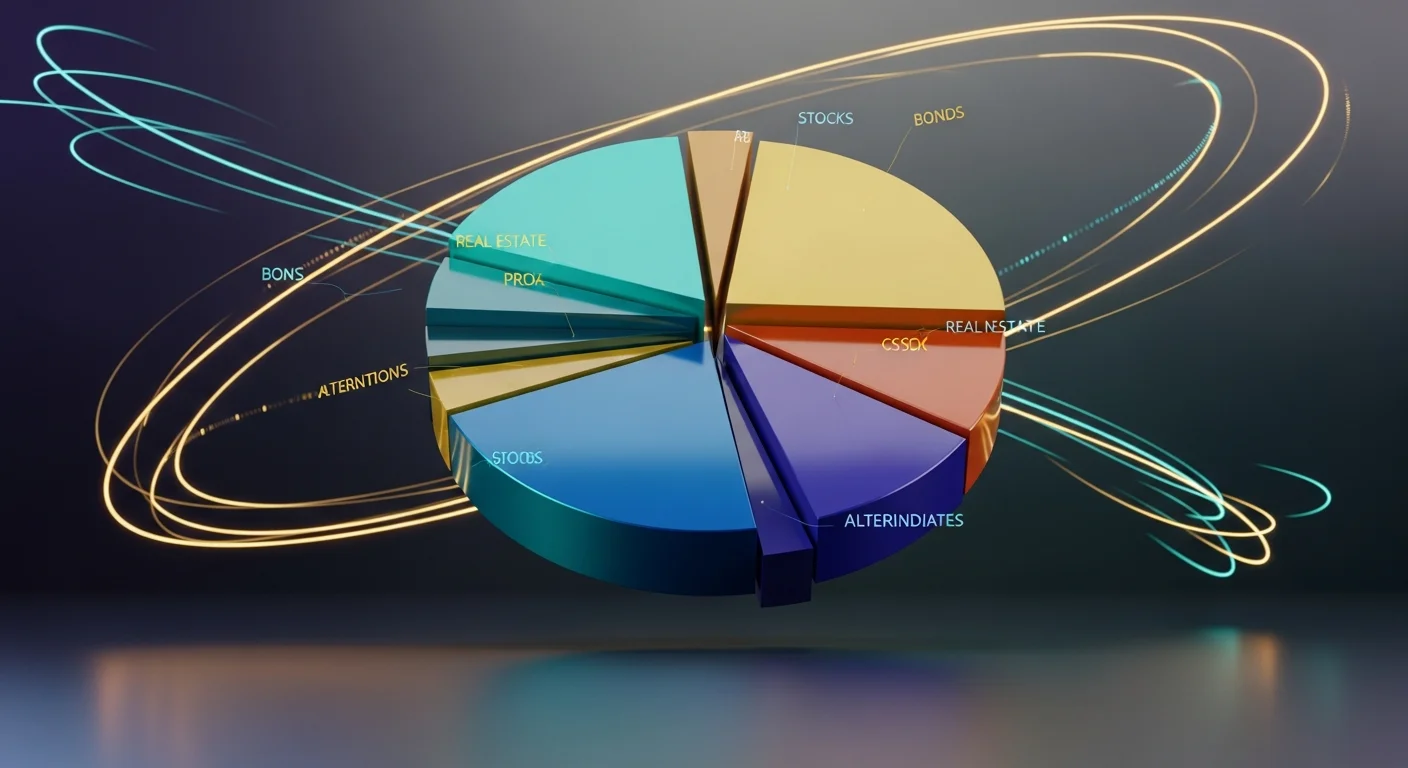
Asset allocation is the most important investment decision you will make. It is how you divide your money between stocks (growth), bonds (stability), and cash (liquidity).
A landmark study originally published in the Financial Analysts Journal by Gary Brinson, L. Randolph Hood, and Gilbert Beebower found that asset allocation explains approximately 90% of the variability in a portfolio's returns over time. Not stock picking. Not market timing. The mix itself.
The "120 Minus Your Age" Framework
The classic rule was "100 minus your age" in stocks. But with longer lifespans and lower bond yields over the past decade, most financial planners now use 110 or 120 minus your age. Here is how it works:
| Your Age | Stocks | Bonds | Cash | Risk Profile |
|---|---|---|---|---|
| 25 | 90-95% | 5-10% | 0-5% | Aggressive growth |
| 30 | 85-90% | 10-15% | 0-5% | Growth |
| 35 | 80-85% | 15-20% | 0-5% | Growth |
| 40 | 75-80% | 20-25% | 0-5% | Moderate growth |
| 45 | 70-75% | 25-30% | 0-5% | Moderate |
| 50 | 65-70% | 25-30% | 5% | Moderate |
| 55 | 60-65% | 30-35% | 5% | Moderate-conservative |
| 60 | 50-60% | 35-45% | 5-10% | Conservative growth |
| 65 | 45-55% | 40-50% | 5-10% | Conservative |
| 70+ | 35-50% | 40-55% | 10-15% | Income and preservation |
These are starting points, not rigid rules. Your actual allocation should factor in your risk tolerance, other income sources (pension, Social Security, rental income), and when you need the money. Someone who is 65 with a generous pension can afford to be more aggressive than someone who is 65 with nothing but their portfolio.
What the Data Shows About Real Portfolios
According to Empower's analysis of actual investor portfolios (January 2026), Americans in their 20s hold 37.5% of their portfolios in cash. That is far too conservative for someone with 40 years until retirement. Meanwhile, investors in their 60s hold only 20% in bonds, which may be too aggressive for someone approaching retirement income needs.
The takeaway: most investors are misallocated. Young people hold too much cash out of fear. Older investors hold too much stock out of greed. An age-appropriate allocation framework keeps you in the rational middle.
Step 2: Choose Your Funds
You do not need 15 different funds. You do not need to pick individual stocks. You do not need to follow market news. What you need is broad, low-cost diversification across the entire global market.
The Three-Fund Portfolio
Popularized by the Bogleheads community (named after Vanguard founder Jack Bogle), the three-fund portfolio is one of the most effective and simple portfolio structures ever devised. It holds:
- A total U.S. stock market fund (captures large, mid, and small-cap U.S. companies)
- A total international stock market fund (captures developed and emerging market companies outside the U.S.)
- A total U.S. bond market fund (provides stability and income)
That is it. Three funds. You own a slice of virtually every publicly traded company on Earth, plus the bond market for ballast. Whether you choose index mutual funds or ETFs for these three positions makes little practical difference for most investors.
Specific Fund Picks by Brokerage
Here are the specific funds that fill each role at the three largest brokerages. All are index funds with expense ratios under 0.20%, meaning you pay less than $20 per year in fees for every $10,000 invested:
| Role | Vanguard | Fidelity | Schwab |
|---|---|---|---|
| Total U.S. Stock Market | VTI (0.03%) or VTSAX | FSKAX (0.015%) or FZROX (0.00%) | SWTSX (0.03%) or SCHB (0.03%) |
| Total International Stock | VXUS (0.07%) or VTIAX | FTIHX (0.06%) or FZILX (0.00%) | SWISX (0.06%) or SCHF (0.06%) |
| Total U.S. Bond Market | BND (0.03%) or VBTLX | FXNAX (0.025%) | SCHZ (0.03%) or SWAGX (0.04%) |
Expense ratios shown are as of early 2026 and are subject to change. Fidelity's FZROX and FZILX have 0.00% expense ratios (zero-fee index funds) but are only available at Fidelity.
Why These Specific Funds?
Total market index funds track thousands of companies at once. VTI, for example, holds over 3,700 U.S. stocks. VXUS holds over 8,500 international stocks. You are not betting on one company or one sector. You are owning the entire market. When the global economy grows, your portfolio grows with it. According to data tracked by NYU Stern, the S&P 500 has produced positive returns over every rolling 20-year period since 1926. The expense ratios listed above mean you pay $3 to $7 per year per $10,000 invested. Compare that to the average actively managed mutual fund, which charges roughly 0.66% ($66 per $10,000), per Morningstar's annual fee study.
Step 3: Build Your Model Portfolio
Now combine your asset allocation (from Step 1) with your fund picks (from Step 2). Here are five model portfolios matched to different life stages.
Portfolio A: The Young Accumulator (Ages 20-35)
Goal: Maximum long-term growth. You have decades before retirement.
| Fund | Allocation | Role |
|---|---|---|
| Total U.S. Stock (VTI / FSKAX / SWTSX) | 60% | U.S. market growth engine |
| Total International Stock (VXUS / FTIHX / SWISX) | 30% | Global diversification |
| Total Bond Market (BND / FXNAX / SCHZ) | 10% | Stability ballast |
With $10,000 to invest: $6,000 in VTI, $3,000 in VXUS, $1,000 in BND. Monthly contributions of $500 would split to $300, $150, and $50 respectively.
Portfolio B: The Mid-Career Builder (Ages 35-45)
Goal: Strong growth with emerging stability. Peak earning years.
| Fund | Allocation | Role |
|---|---|---|
| Total U.S. Stock (VTI / FSKAX / SWTSX) | 50% | Core growth |
| Total International Stock (VXUS / FTIHX / SWISX) | 25% | Global diversification |
| Total Bond Market (BND / FXNAX / SCHZ) | 25% | Increasing stability |
Portfolio C: The Pre-Retiree (Ages 45-55)
Goal: Balanced growth and preservation. Retirement is visible on the horizon.
| Fund | Allocation | Role |
|---|---|---|
| Total U.S. Stock (VTI / FSKAX / SWTSX) | 45% | Continued growth |
| Total International Stock (VXUS / FTIHX / SWISX) | 20% | Global exposure |
| Total Bond Market (BND / FXNAX / SCHZ) | 35% | Stability and income |
Portfolio D: The New Retiree (Ages 55-65)
Goal: Capital preservation with enough growth to outpace inflation. Income generation matters.
| Fund | Allocation | Role |
|---|---|---|
| Total U.S. Stock (VTI / FSKAX / SWTSX) | 35% | Inflation protection and growth |
| Total International Stock (VXUS / FTIHX / SWISX) | 15% | Global diversification |
| Total Bond Market (BND / FXNAX / SCHZ) | 45% | Income and stability |
| Cash / Money Market | 5% | Near-term spending needs |
At this stage, you might also consider adding a dividend-focused fund to generate regular income from your portfolio.
Portfolio E: The Established Retiree (Ages 65+)
Goal: Sustainable income, capital preservation, and enough growth to fund a 25-30 year retirement.
| Fund | Allocation | Role |
|---|---|---|
| Total U.S. Stock (VTI / FSKAX / SWTSX) | 30% | Growth to outpace inflation |
| Total International Stock (VXUS / FTIHX / SWISX) | 10% | Diversification |
| Total Bond Market (BND / FXNAX / SCHZ) | 50% | Income and stability |
| Cash / Money Market | 10% | 1-2 years of spending needs |
A common mistake retirees make is going 100% bonds or cash. You still need stocks. A 65-year-old today has an average life expectancy of about 20 more years, per Social Security actuarial tables. Twenty years is a long time horizon. Without stocks, inflation will slowly erode your purchasing power.
Step 4: The Rebalancing System Most Investors Skip
Here is a scenario that happens to every portfolio. You set a 70/30 stock-to-bond allocation. Stocks have a great year and jump 25%. Bonds return 4%. Your portfolio is now 76/24. You have more risk than you planned for. If a crash comes, you will lose more than you bargained for.
Rebalancing means selling what has grown beyond its target and buying what has fallen below it. It is the disciplined opposite of what your emotions want you to do (buy more of what is going up, sell what is going down).
How Often to Rebalance
Research from Vanguard compared multiple rebalancing strategies and found that the specific frequency matters less than simply doing it at all. Their findings:
- Best approach: Rebalance when any asset class drifts more than 5 percentage points from its target (called "threshold rebalancing"). This keeps you close to your target without unnecessary trades
- Good approach: Rebalance once per year on a set date (your birthday, New Year's, tax day)
- Also works: Rebalance whenever you add new money. Direct new contributions into whichever asset class is below its target weight
The Tax-Smart Way to Rebalance
In tax-advantaged accounts (401(k), IRA, Roth IRA), rebalance freely. There are no tax consequences for buying and selling inside these accounts.
In taxable brokerage accounts, rebalancing by selling triggers capital gains taxes. Instead, use these strategies:
- Direct new contributions into the underweight asset class
- Reinvest dividends into the underweight fund rather than the fund that paid them
- Use tax-loss harvesting to offset gains when you do need to sell. Swap a fund for a similar (but not identical) one to capture a tax loss while maintaining your allocation. Our tax-loss harvesting guide explains the rules and process
Step 5: Set Up Automation and Stay the Course
The biggest threat to your portfolio is not the stock market. It is you. Specifically, it is the temptation to check your balance daily, panic when markets drop, and change your plan based on whatever headline you read this morning.
Automate Everything
- Set up automatic transfers from your checking account to your brokerage on payday. Treat investing like a bill that must be paid
- Enable automatic dividend reinvestment (DRIP) so dividends buy more shares without you lifting a finger
- If your 401(k) allows it, set up automatic annual contribution increases of 1% per year until you hit the maximum
The Cost of Getting Emotional
Here is what happens when investors react to fear instead of sticking to a plan:
According to J.P. Morgan's 2025 Guide to the Markets, if you invested $10,000 in the S&P 500 on January 1, 2005 and stayed invested through December 31, 2024 (20 years), your investment grew to approximately $71,750. But if you missed just the 10 best days during that entire 20-year span, your balance dropped to roughly $32,870. Missing the 20 best days? About $20,000. Missing the 30 best days? Roughly $14,000.
The best days almost always happen right after the worst days, when panicked investors have already sold. Staying invested is not a suggestion. It is the single most important thing you can do.
The Dollar-Cost Averaging Advantage
Investing a fixed amount at regular intervals (say, $500 on the 1st of every month) means you automatically buy more shares when prices are low and fewer when prices are high. Over time, this lowers your average cost per share. It also removes the impossible question of "when should I invest?" The answer is always: on your scheduled day, regardless of what the market is doing.
The Five Biggest Portfolio Mistakes (and How to Avoid Each One)
Mistake 1: Holding Too Much Cash
Empower's data shows investors in their 20s hold 37.5% of their portfolios in cash. At age 25, assuming a 30-year timeline and a 7% average annual stock return versus a 4% savings account return, every $10,000 held in cash instead of invested costs you roughly $46,000 in lost growth by age 55.
Cash belongs in your emergency fund and for expenses within the next 1 to 3 years. Everything else should be invested according to your allocation.
Mistake 2: Chasing Performance
The top-performing fund category in any given year is almost never the top performer the following year. According to S&P Dow Jones Indices' Persistence Scorecard, only about 3% of top-quartile large-cap funds maintained their top ranking three years later. Chasing last year's winner means you are buying high and almost certainly going to be disappointed.
Mistake 3: Paying High Fees
The difference between a 0.03% expense ratio and a 1.0% expense ratio sounds tiny. It is not. On a $100,000 portfolio growing at 7% over 30 years, the low-cost fund leaves you with roughly $740,000. The high-cost fund leaves you with $574,000. That 0.97% annual difference costs you $166,000. Check the expense ratio of every fund you own.
Mistake 4: Ignoring Tax Location
Where you hold specific investments matters for tax efficiency. The general principle:
- Tax-advantaged accounts (401(k), IRA): Hold bonds and bond funds here. Bond interest is taxed as ordinary income, so sheltering it makes sense
- Roth accounts: Hold your highest-growth investments here (stocks, especially small-cap and international). Growth is tax-free forever
- Taxable brokerage accounts: Hold tax-efficient stock index funds (which generate minimal capital gains distributions) and municipal bonds if you are in a high tax bracket
Mistake 5: Overcomplicating It
Adding more funds does not automatically mean more diversification. A total U.S. stock market fund already holds 3,700+ companies. Adding a separate large-cap fund, a separate mid-cap fund, and a separate small-cap fund on top of it just creates overlap and makes rebalancing harder. Simplicity is a feature, not a limitation.
How Much Should You Be Investing?
There is no universal answer, but these benchmarks from Fidelity's retirement guidelines are widely cited:
| By Age | Savings Target | Annual Savings Rate |
|---|---|---|
| 30 | 1x your annual salary saved | 15% of gross income (including employer match) |
| 40 | 3x your annual salary saved | 15% of gross income |
| 50 | 6x your annual salary saved | 15% to 20% of gross income |
| 60 | 8x your annual salary saved | Max out available accounts |
| 67 | 10x your annual salary saved | Retirement ready |
If you are behind, do not panic. Increasing your savings rate by even 1% per year makes a meaningful difference over a decade. And if you are just starting, the best time to begin was ten years ago. The second best time is right now.
Frequently Asked Questions
Should I invest a lump sum all at once or spread it out over time?
Research from Vanguard analyzed data across the U.S., U.K., and Australian markets and found that lump-sum investing outperformed dollar-cost averaging about two-thirds of the time. This makes sense because markets tend to go up over time, so the sooner your money is invested, the longer it benefits from growth. However, if investing a large amount all at once causes you so much anxiety that you might panic-sell during the next downturn, spreading it out over 6 to 12 months is the psychologically safer choice. A slightly suboptimal strategy you stick with beats an "optimal" strategy you abandon.
How much international stock exposure do I really need?
The global stock market is roughly 60% U.S. and 40% international by market capitalization. Vanguard recommends allocating up to 40% of your stock holdings to international funds. Jack Bogle himself suggested 20% was sufficient, arguing that U.S. multinationals already earn significant revenue overseas. A reasonable range is 20% to 40% of your stock allocation in international funds. The model portfolios in this guide use approximately 30% to 35% international (as a percentage of total stock holdings), which falls in the middle of expert recommendations. The key is to have some meaningful international exposure rather than being 100% U.S., which leaves you concentrated in a single country's economy.
What if I cannot afford to invest 15% of my income right now?
Start with whatever you can. If that is $50 per month, start with $50. If your employer offers a 401(k) match, contribute at least enough to capture the full match (it is free money). Then increase your contribution by 1% every time you get a raise. Most people can absorb a 1% increase without noticing a lifestyle change. Over five years of raises, you go from 3% to 8% without ever feeling a pinch. The most important thing is to start. Compound growth rewards time more than it rewards amount.
Should I use a target-date fund instead of building my own portfolio?
Target-date funds are an excellent choice if you prefer a completely hands-off approach. You pick the fund with a date closest to your expected retirement year (like Vanguard Target Retirement 2055), and the fund automatically adjusts its stock-to-bond ratio as you age. The tradeoff is slightly higher expense ratios (Vanguard's target-date funds charge 0.08% versus 0.03% for individual index funds) and less control over your exact allocation. For a detailed comparison, see our target-date funds vs. DIY portfolio analysis. For most people, either approach works. The best choice is the one you will actually stick with through market ups and downs.
When should I start shifting from stocks to bonds?
The shift should be gradual, not sudden. Using the "120 minus your age" framework, you naturally increase your bond allocation by about 1 percentage point per year. A 30-year-old holding 10% bonds becomes a 40-year-old holding 20% bonds and a 50-year-old holding 30% bonds. This happens through your annual rebalancing process. Do not make dramatic shifts based on market conditions or headlines. A common mistake is moving to 80% bonds at age 50 because you are "scared of a crash." That level of conservatism means your portfolio may not keep pace with inflation over a 30+ year retirement.
Is it too late to start investing at 40 or 50?
Absolutely not. At age 40, you likely have 25 or more years until retirement. At 50, you have 15 to 17 years plus catch-up contribution limits ($31,000 in a 401(k) for those 50+; $34,750 for ages 60-63 under SECURE 2.0 super catch-up provisions). Even at 50, investing $1,000 per month at a 7% average return grows to approximately $380,000 by age 67. The key is to start immediately, maximize your tax-advantaged contributions (especially catch-up contributions), and resist the temptation to take excessive risk to "make up for lost time." Aggressive bets to catch up often backfire and leave you worse off.
Do I need to add real estate, gold, or crypto to my portfolio?
The three-fund portfolio already includes real estate exposure through REITs (Real Estate Investment Trusts) that are held within total stock market index funds. For most investors, this is sufficient real estate exposure. Gold has historically returned about 1% above inflation over very long periods, which is less than stocks. It can serve as a hedge against extreme uncertainty, but it is not necessary for a well-diversified portfolio. Cryptocurrency is highly speculative and volatile. If you choose to allocate to crypto, most financial advisors suggest limiting it to 1% to 5% of your total portfolio and only money you could afford to lose entirely. None of these additions are required for a successful long-term portfolio.
How do I handle investing during a market crash?
Continue investing according to your plan. This is the hardest advice to follow and the most important. Every major market crash in history (1929, 1987, 2000, 2008, 2020) was followed by a recovery that eventually exceeded the previous high. During the 2008 financial crisis, the S&P 500 dropped 57% from peak to trough. An investor who stayed the course and kept contributing saw their portfolio not only recover but grow substantially over the following decade. If your allocation has drifted significantly due to a crash (say, stocks dropped from 70% to 55% of your portfolio), your rebalancing process will naturally have you buying stocks at low prices. This is the mechanism by which disciplined investors buy low. It feels terrible in the moment. It works brilliantly over time.
Financial Disclaimer: This article is for educational purposes only and does not constitute investment, financial, or tax advice. Past performance does not guarantee future results. All investments carry risk, including the potential loss of principal. The specific funds mentioned are examples for illustration purposes and are not recommendations to buy or sell any particular security. Fund expense ratios, contribution limits, and tax rules are subject to change. Your individual circumstances, including income, tax situation, time horizon, and risk tolerance, should guide your investment decisions. Consult with a qualified financial advisor before making investment decisions. The model portfolios shown are simplified examples and may not be appropriate for your specific situation.
About the Author: This article was researched and written by Asim Ahmad using data from Vanguard, Fidelity, J.P. Morgan, S&P Dow Jones Indices, Morningstar, the Federal Reserve, the Social Security Administration, and Empower. All statistics are sourced from their original publications and linked for verification. Last updated: February 2026.
Related Reading
- Capital Gains Tax Guide 2026 - Tax-efficient investing across your portfolio
- Tax-Loss Harvesting Complete Guide 2026 - Boost after-tax returns through strategic loss selling
- Long-Term Capital Gains Tax 2026 - Why long-term asset allocation pays double dividends
- Index Funds vs ETFs 2026 - Tax efficiency comparison to guide your portfolio structure